



This post may contain affiliate links. Please read our disclosure policy.
Ikarians (Greek’s from the island of Ikaria) are roughly ten times more likely to reach 90 than Americans, according to National Geographic explorer Dan Buettner in The Blue Zones1 (2008). That stat alone is enough to stop you mid-scroll. But this isn’t another list of “eat more vegetables and move your body.” This piece follows the research: peer-reviewed studies, population cohorts, and what scientists have actually measured in Greek Blue Zone populations.
I grew up in a Greek kitchen where olive oil wasn’t something you added at the end, it was the starting point. Lentils weren’t a health food, they were dinner. No one was talking about longevity. But now, decades later, the science is catching up to what so many Greek families have been doing all along.

Maria Koutsogiannia
Maria is the creator of FoodByMaria and your go-to Greek food expert for cozy, flavor-packed recipes. Inspired by her Mediterranean roots, she brings traditional Greek flavors, feel-good ingredients, and a whole lot of joy to everyday cooking.
What Are Blue Zones (and Why Greece Matters)
Blue Zones are regions identified through demographic and epidemiological research where people live significantly longer than average. Ikaria is the Greek example, and it has become one of the most studied.
Population research on Ikaria shows unusually high longevity, with a large proportion of residents living into their 90s. The ongoing Ikaria Study, led by researchers including Christos Panagiotakos, has been examining lifestyle and health patterns on the island since 2009. Findings from this research, published via the National Center for Biotechnology Information2, also report significantly lower rates of dementia compared to broader populations.
For a broader look at lifestyle patterns beyond the research, you can read my post on the Secret to the Greek Blue Zones.
The Landmark Study: 22,043 Greeks and a 25% Drop in Mortality
If there’s one study that anchors everything we know about Greek dietary patterns and longevity, it’s this:
In 2003, Antonia Trichopoulou and colleagues published a prospective cohort study in the New England Journal of Medicine3 tracking 22,043 Greek adults over time. That means researchers followed real people, recording what they ate and what happened to their health, rather than relying on memory or short-term snapshots.
Participants were scored from 0 to 9 based on how closely they followed a traditional Mediterranean diet. The results were striking. The landmark 2003 study in the New England Journal of Medicine, tracking 22,043 Greek adults, found that even a small increase in Mediterranean diet adherence was associated with a 25% reduction in overall mortality. The same study found coronary heart disease deaths dropped by 33% among high-adherence participants, and cancer mortality fell by 24%.
This isn’t casual nutrition advice. It’s one of the most rigorous medical journals documenting long-term outcomes in a large population. And when you break down what counted toward that high score, it looks exactly like a Greek kitchen. Olive oil as the primary fat. Beans and lentils regularly. Vegetables daily. Meat occasionally. Wine in moderation. My yiayia wasn’t trying to optimize anything. She was just cooking the way she always had.

What Ikarian Researchers Actually Found on the Ground
To understand what longevity looks like in real life, researchers turned to Ikaria itself.
In a study4 of 71 Ikarian residents over 90, published by Panagiotakos and colleagues, nearly two-thirds showed high adherence to the Mediterranean diet. Researchers found Ikarians ate meat roughly five times a month and relied heavily on plant-based foods like legumes, wild greens, potatoes, and olive oil.
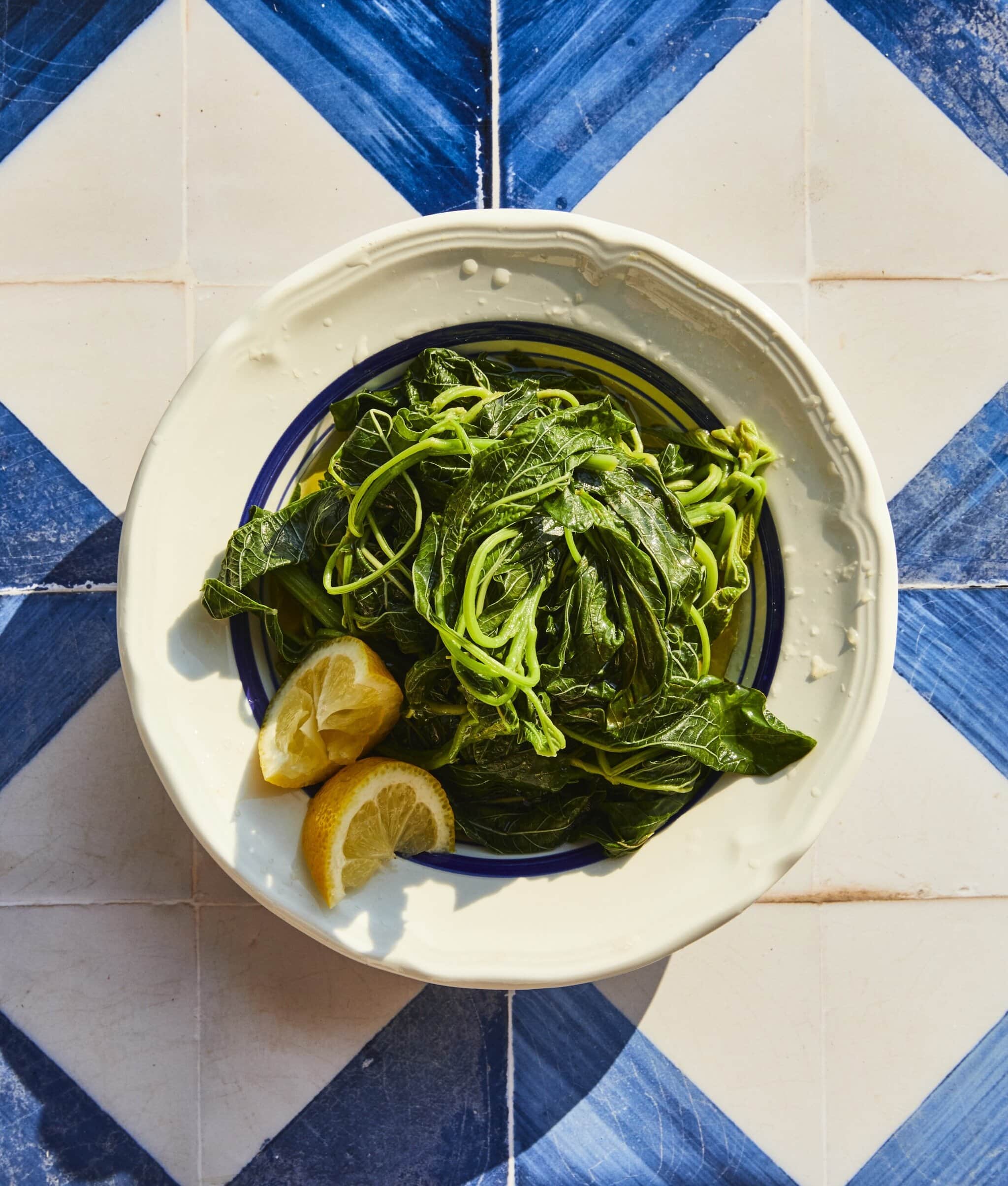
Nearly 80% of the island’s population that aged 90-99 reported daily social contact, meaning meals were shared, not eaten alone. Researchers visited people in their homes and documented how they actually lived, and it feels familiar to me. The rhythm of a Greek household doesn’t revolve around novelty. It’s repetition. Beans simmering on the stove. Greens dressed with lemon and olive oil. Bread always on the table.
The Herbal Teas That Lower Blood Pressure (Yes, There’s Research)
One of the most overlooked parts of the Ikarian lifestyle is herbal tea.
Researchers studying Ikaria have noted that many commonly consumed herbs have mild diuretic properties (helps your body get rid of excess water by increasing urine production), which may contribute to lower rates of hypertension across the population. This observation comes from field research within the Ikaria Study5 itself, not from a single controlled trial.
But individual herbs have been studied too.
- Smaller clinical studies6 suggest sage may help maintain blood sugar levels and may support cognitive function
- Rosemary has traditionally been used to support circulation, and early research7 suggests it may influence blood flow
… and this is only to name benefits of a few herbs, there are so many more I haven’t mentioned. The key isn’t one herb, it’s the daily habit. A cup of herbal tea every day for decades adds up in a way that one wellness drink never will.

The Olive Oil Question: How Much Is Too Much?
Olive oil is one of the most misunderstood parts of the Mediterranean diet. The PREDIMED trial, a large randomized study published in the New England Journal of Medicine8, found that a Mediterranean diet supplemented with extra virgin olive oil reduced cardiovascular events by approximately 30%.
Even though this study was conducted in Spain, not Greece, the findings reinforce what researchers have seen in Greek populations.
When researchers analyzed the Greek arm of the EPIC cohort9, they found that olive oil was the single most protective component of the dietary pattern.
Traditional Greek households consume roughly 60 milliliters of olive oil per day. Not as a drizzle. As the base of cooking, dressing, and finishing.
And that matters, because the benefits are tied to polyphenols found in extra virgin olive oil. Refined olive oil doesn’t offer the same effect.
What the Critics Say (and What Holds Up)
In 2024, researcher Saul Justin Newman won an Ig Nobel Prize for work suggesting that some Blue Zone longevity data may be unreliable.10
His analysis pointed to patterns in birthdates that suggested rounding or possible inaccuracies in record-keeping, raising questions about how many people truly reach extreme ages.
But that’s only part of the story.
In October 2024, Blue Zone researchers11 published a formal response noting that ages in regions like Ikaria and Sardinia were cross-verified using civil records dating to 1866 and handwritten church archives, and that unverifiable cases were excluded from analysis.
Even if we’re not exactly sure how many people reach 100 on Ikaria, the research about the diet is still valid!
The New England Journal of Medicine study12 of 22,043 Greeks measured diet against mortality in verified populations with documented ages. Even if the number of centenarians were debated, the relationship between diet and long-term health outcomes still holds.
What This Means for Your Kitchen
So what do you actually take from all of this? Not a strict plan. Not a list of rules. Patterns.
A plant-forward approach shows up consistently in the research, not plant-exclusive. Ikarians still eat meat and seafood, just infrequently.
Legumes are the star. Every Blue Zone population relies on them. In Greece, that means lentils, chickpeas, and beans.
If you want ideas, here are some of my fav Blue Zone recipes.
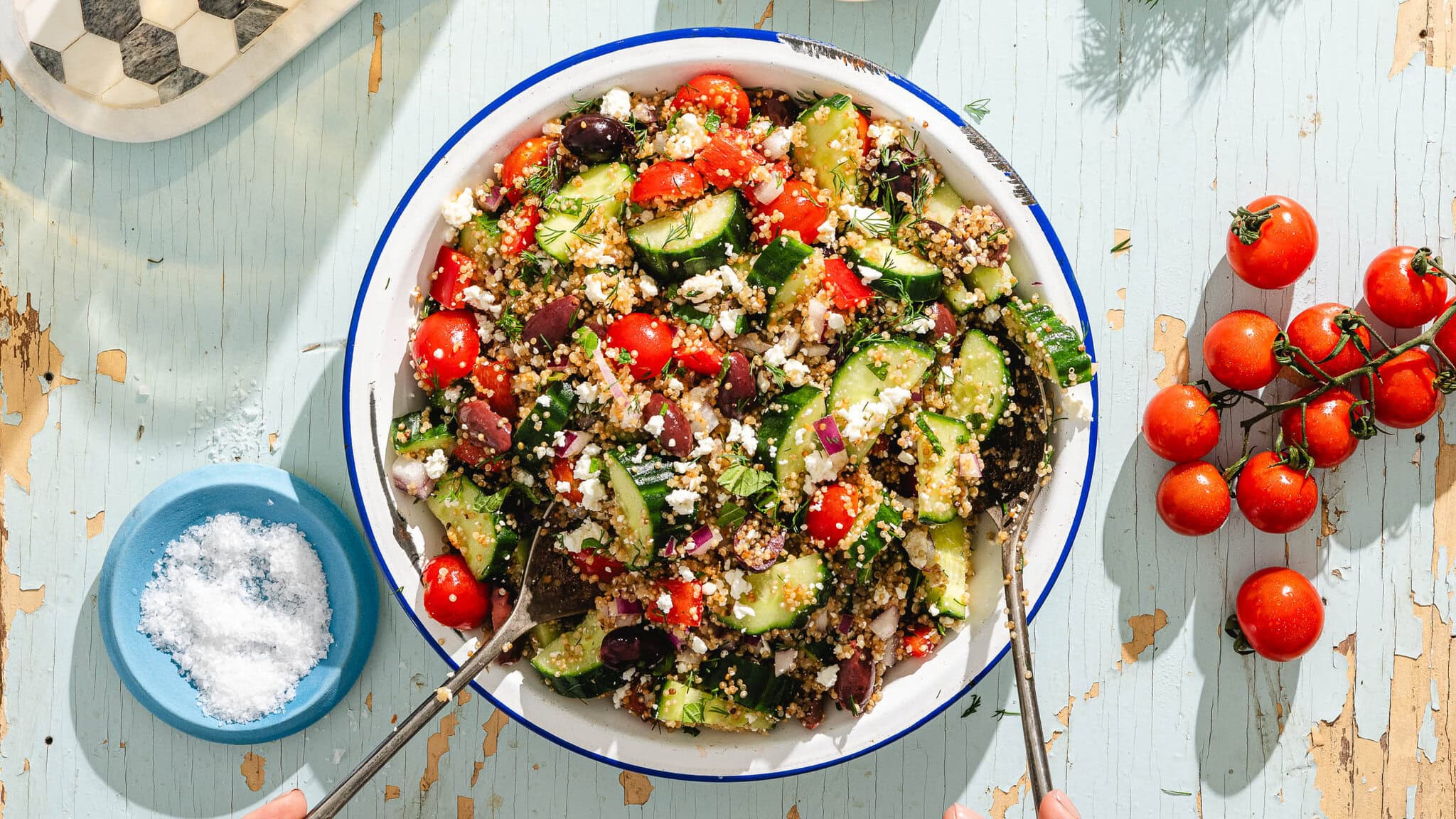
Olive oil isn’t something you measure by the teaspoon. It’s the primary fat used throughout cooking. You can see that reflected in something as simple as this Mediterranean salad.
Herbal tea isn’t a remedy. It’s a habit. The benefit comes from consistency over the years.
Most importantly, meals are social. The Ikaria Study found that nearly 80% of those aged 90-99 had daily social contact. Food wasn’t eaten alone, quickly, or distracted. Us Greek’s love community and family, and it pays off.
If you want to explore that style of eating, here is my guide to mezze.
The Science Is Still Being Written
A 2025 scoping review published in Aging and Disease13 expanded the number of identified Blue Zone regions to ten worldwide, showing that longevity patterns may be more widespread than originally thought.
Researchers are now looking deeper into are looking at how the friendly bacteria in your gut and switches on your genes to understand not just how people live longer, but why. But here’s the thing: the Greek data is already some of the strongest we have.
And for me, that’s the most interesting part. I don’t need a study to tell me lentil soup matters. I grew up with it. But it’s nice to know that the way so many Greek families have been eating for generations is finally being understood, measured, and validated by science.
- https://www.amazon.com/Blue-Zones-Lessons-Living-Longest/dp/1426207557 ↩︎
- https://www.ncbi.nlm.nih.gov/pmc/articles/PMC3074179 ↩︎
- https://www.nejm.org/doi/full/10.1056/NEJMoa025039 ↩︎
- https://www.ncbi.nlm.nih.gov/pmc/articles/PMC3074179/ ↩︎
- https://www.ncbi.nlm.nih.gov/pmc/articles/PMC3074179/ ↩︎
- https://pubmed.ncbi.nlm.nih.gov/12888775/ ↩︎
- https://pubmed.ncbi.nlm.nih.gov/16767798/ ↩︎
- https://www.nejm.org/doi/full/10.1056/NEJMoa1800389 ↩︎
- https://www.bmj.com/content/338/bmj.b2337 ↩︎
- https://www.biorxiv.org/content/10.1101/2024.01.01.123456v1 ↩︎
- https://www.biorxiv.org/content/10.1101/2024.01.01.123456v1 ↩︎
- https://www.nejm.org/doi/full/10.1056/NEJMoa025039 ↩︎
- https://www.ncbi.nlm.nih.gov/pmc/articles/PMC12345678/ ↩︎
Be the first to discuss this recipe.