This post may contain affiliate links. Please read our disclosure policy.
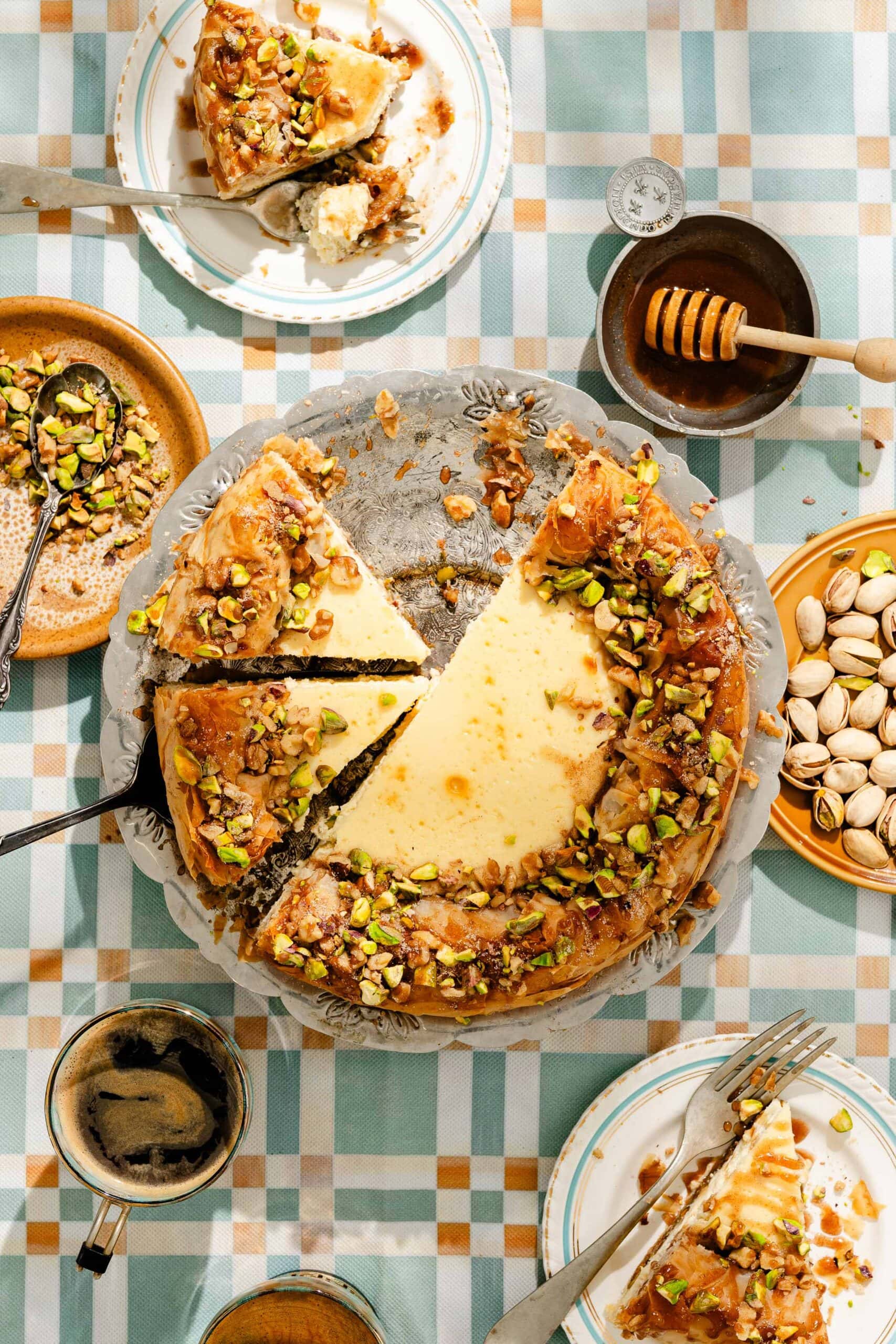
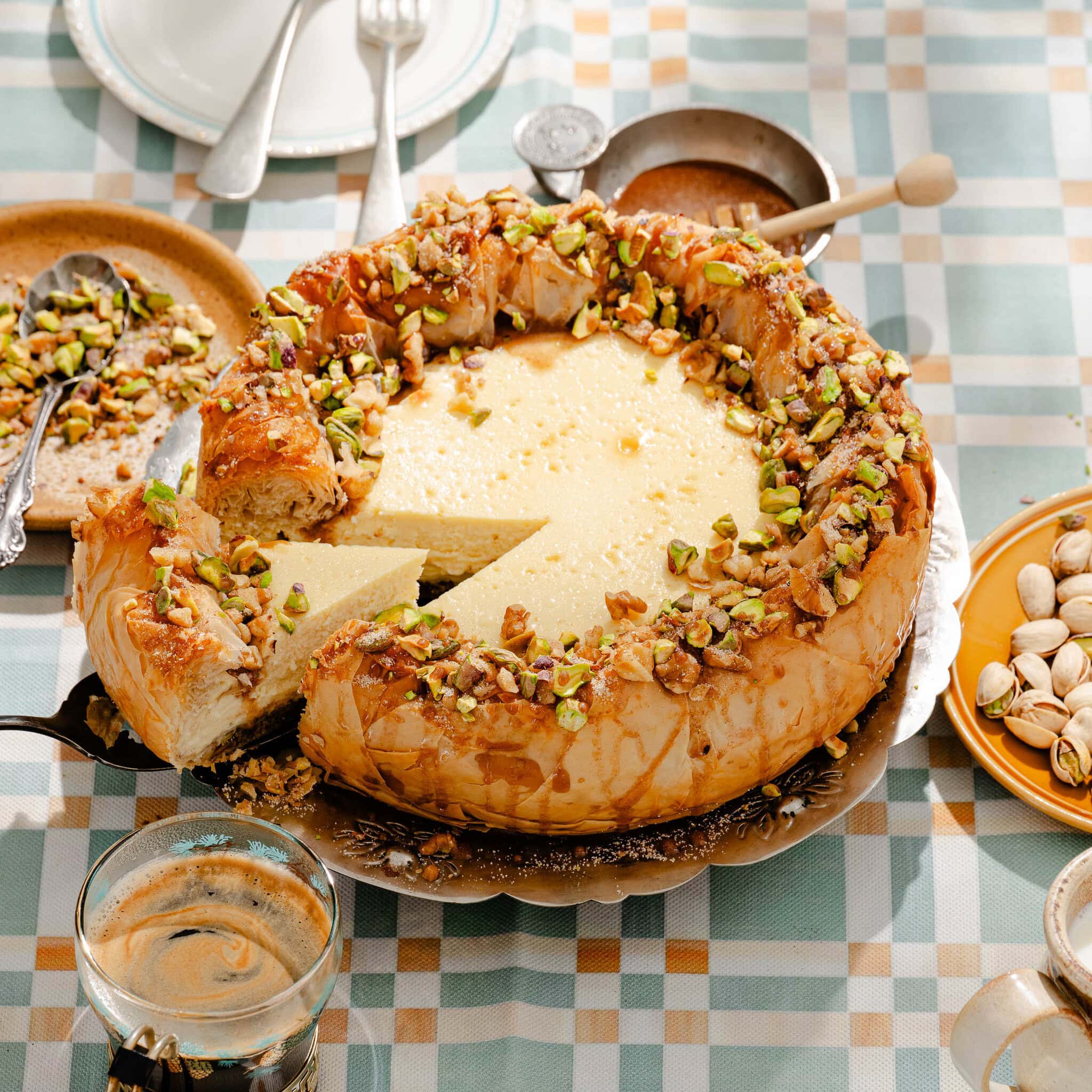
This Baklava Cheesecake has a creamy, lemon-bright labneh cheesecake center wrapped in buttery phyllo, with pistachios, walnuts, cinnamon, cardamom, and honey throughout. It’s for those moments when you can’t decide between cheesecake and baklava.
I spent many summers in Greece visiting family, and there is something about the combination of flaky phyllo, nuts, honey, and warm spices that always feels familiar and comforting. This is not a traditional Greek cheesecake, but it carries those beautiful flavors together in a way that feels incredibly special.

Maria Koutsogiannia
Maria is the creator of FoodByMaria and your go-to Greek food expert for cozy, flavor-packed recipes. Inspired by her Mediterranean roots, she brings traditional Greek flavors, feel-good ingredients, and a whole lot of joy to everyday cooking.
Why You’ll Love This Baklava Cheesecake
Crisp meets creamy
The best part of this cheesecake is the contrast. You get that delicate, buttery phyllo edge that shatters as you cut into it, then a creamy filling that melts in your mouth. That flaky edge gives every creamy bite a little crackle.
The flavor has a point
Every ingredient has a job, and together they create that baklava-inspired flavor profile. Salted pistachios bring richness, walnuts add depth, and cinnamon and cardamom bring that warm spice that makes every bite feel cozy.
The lemon brightens the labneh and cream cheese filling so it never feels too heavy, while the cinnamon honey drizzled around the phyllo edge and sides adds the perfect fragrant sweetness. If you love the flavors of baklava, this pistachio baklava cheesecake brings them into a creamy baked dessert!
A proper make-ahead dessert
This is the kind of dessert that works well for holidays, dinner parties, or any time you want something impressive that you can prepare in advance.
Looking for another yummy dessert with honey, nuts, and warm spices? My Baklava Cake is another option for a Greek dessert table.
A rustic finish, no water bath required
This cheesecake gets its rustic look from the phyllo, not a complicated decorating process. The recipe bakes in a 9-inch springform pan on a baking sheet, where the overhanging phyllo turns golden and crinkled around the centre.
You’re looking for crisp phyllo at the edges and a creamy centre.
Key Ingredients and What Makes Them Work
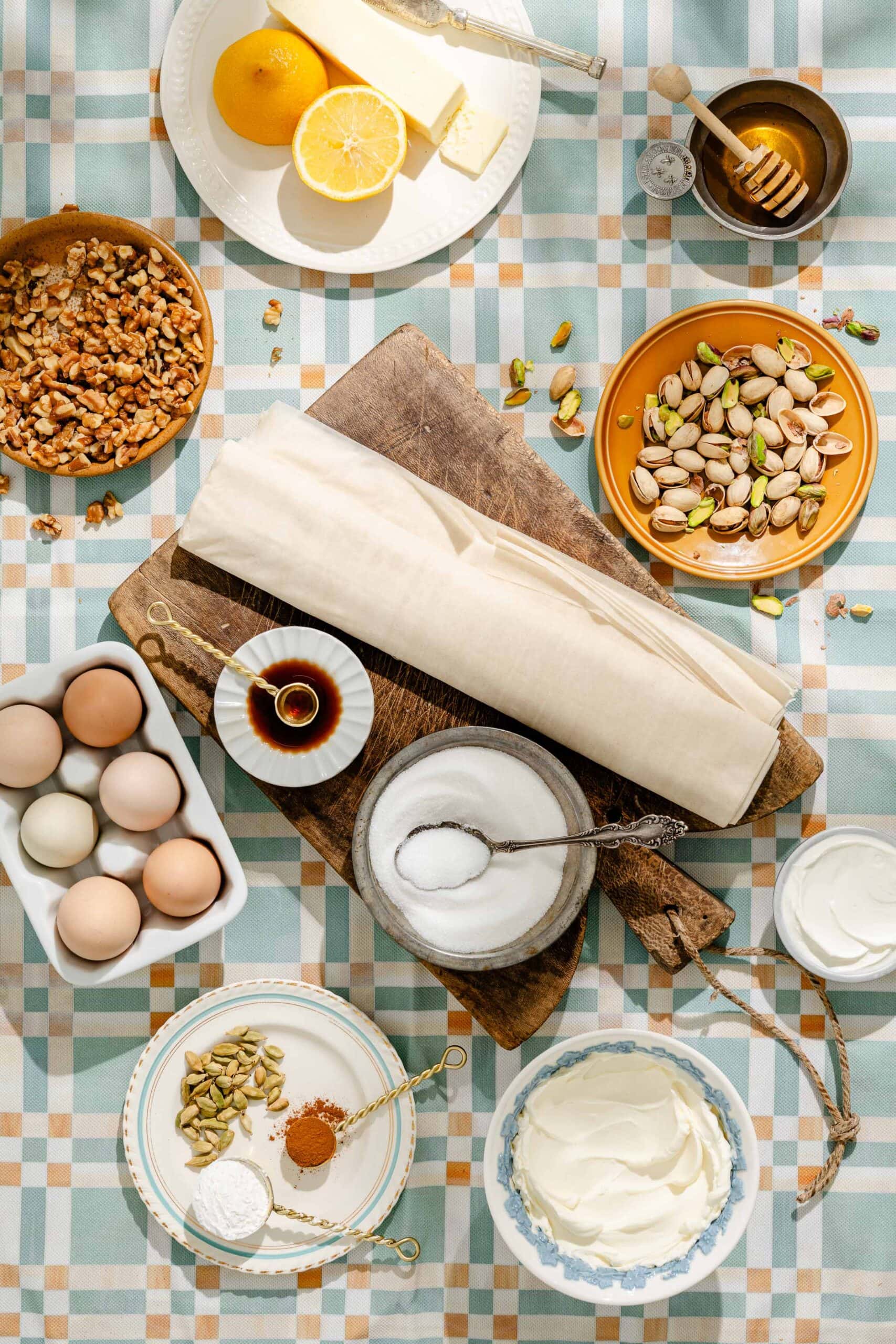
Cream cheese, labneh, eggs, and cornstarch
The recipe calls for cream cheese, labneh, eggs, and cornstarch to all be at room temperature before mixing. This matters because ingredients at the same temperature blend together more evenly, helping you create a smooth filling without needing to overmix.
Once the eggs are added, mix only until combined. Adding too much air during mixing can cause baked cheesecakes to puff in the oven and then crack as they cool.
Phyllo and melted butter
Phyllo is what gives this cheesecake its signature crisp pastry structure. The butter-brushed layers create separation, so instead of a traditional cheesecake crust, you get flaky layers surrounding the filling.
If flaky pastry layered with nuts, honey, and warm spices is your jam, you’ll also want to try my Baklava Recipe for another classic combination of these flavors.
Pistachios, walnuts, cinnamon, and cardamom
The nut and spice layer is where the baklava inspiration really shines. The recipe uses salted pistachios and unsalted walnuts intentionally, creating a balanced mix of richness, texture, and seasoning. Cinnamon and cardamom bring warmth without overpowering the creamy filling. They are the flavors that make every forkful feel cozy and aromatic.
Honey and cinnamon
The finishing touch is the cinnamon honey. After the cheesecake has chilled, it is drizzled around the phyllo edge and sides. That final touch brings everything together!
Technique Overview
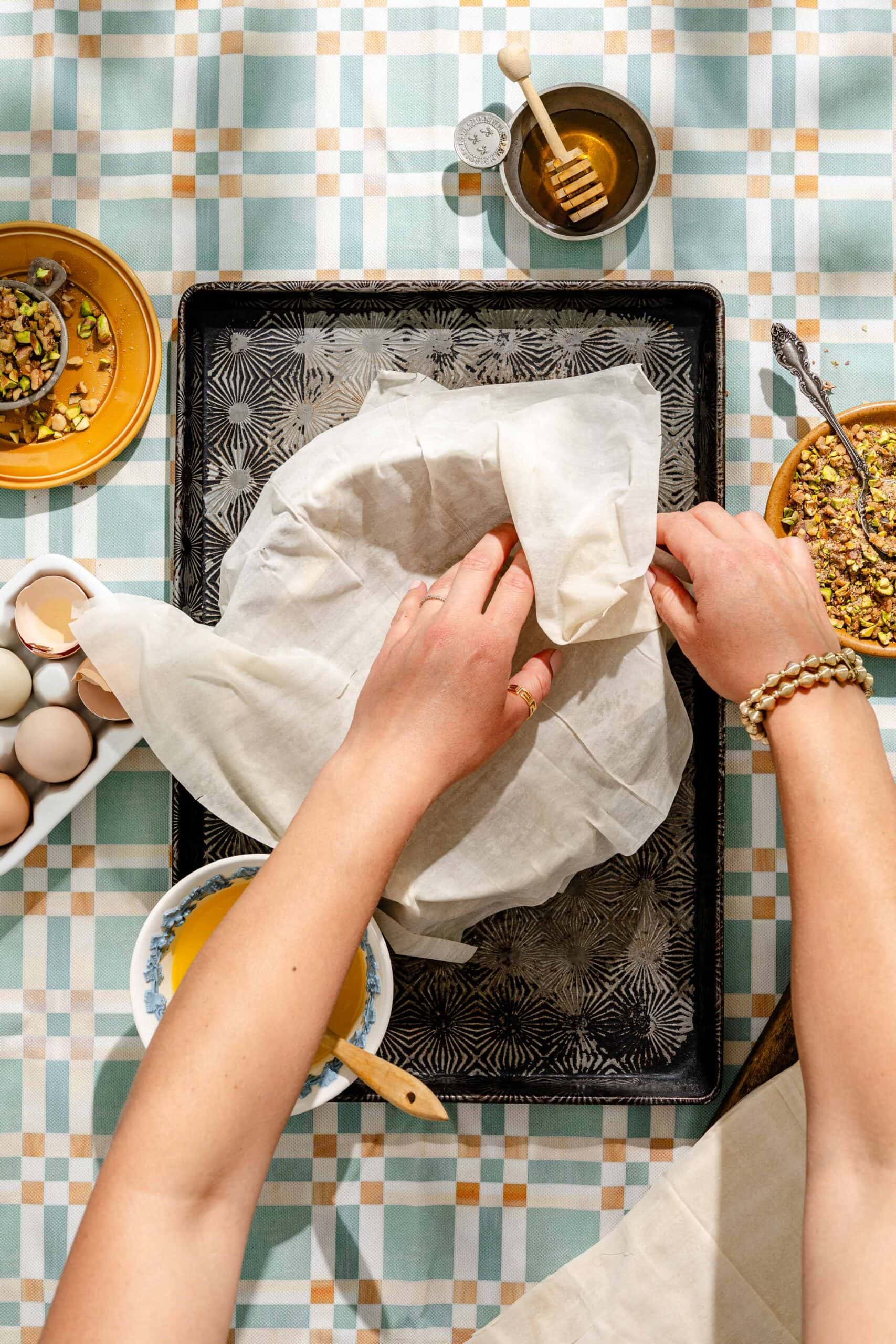
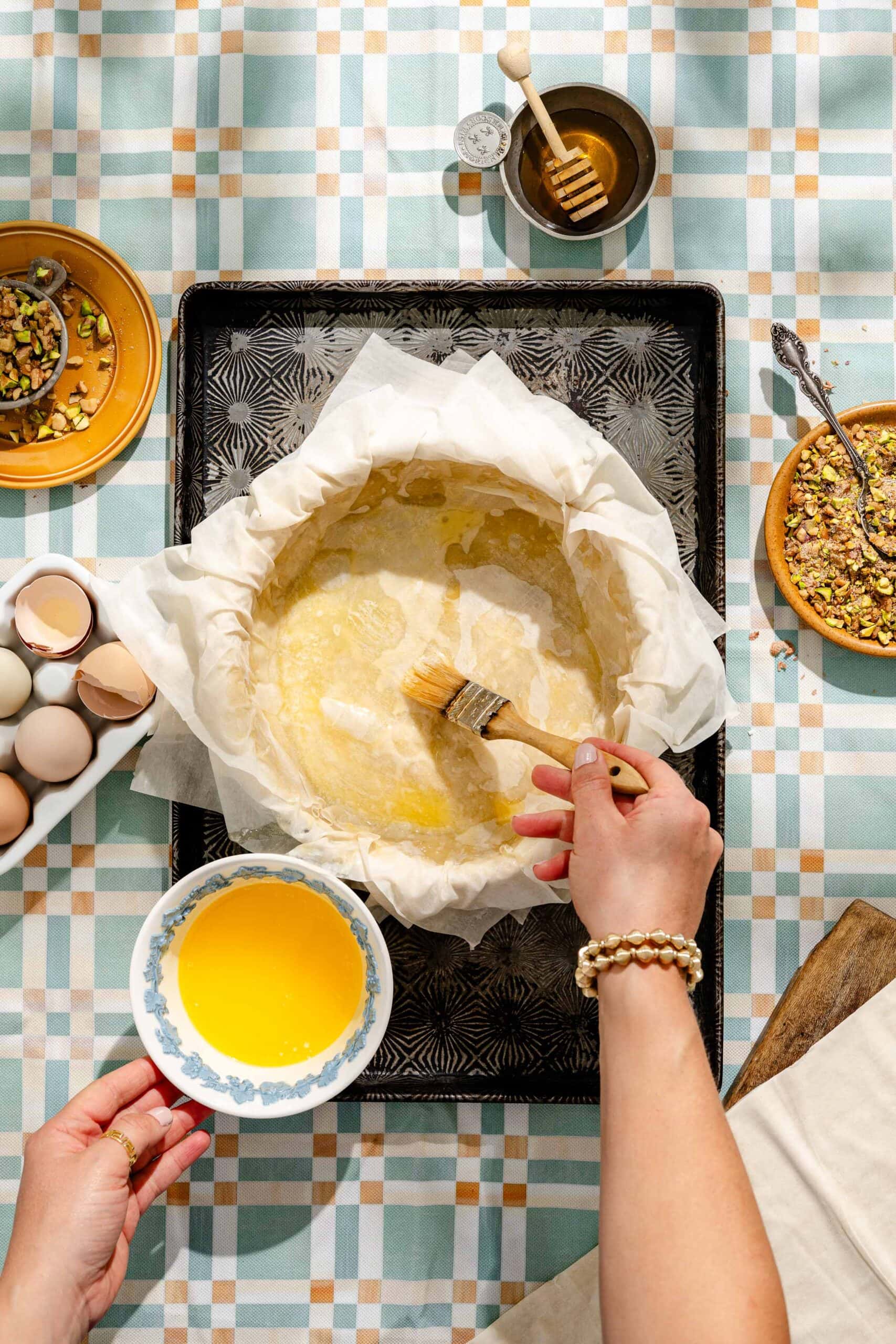
The recipe uses a buttered 9-inch springform pan placed on a baking sheet, with a base of layered phyllo, a single pistachio-walnut-spice layer, more phyllo, and a creamy cream cheese-labneh filling.
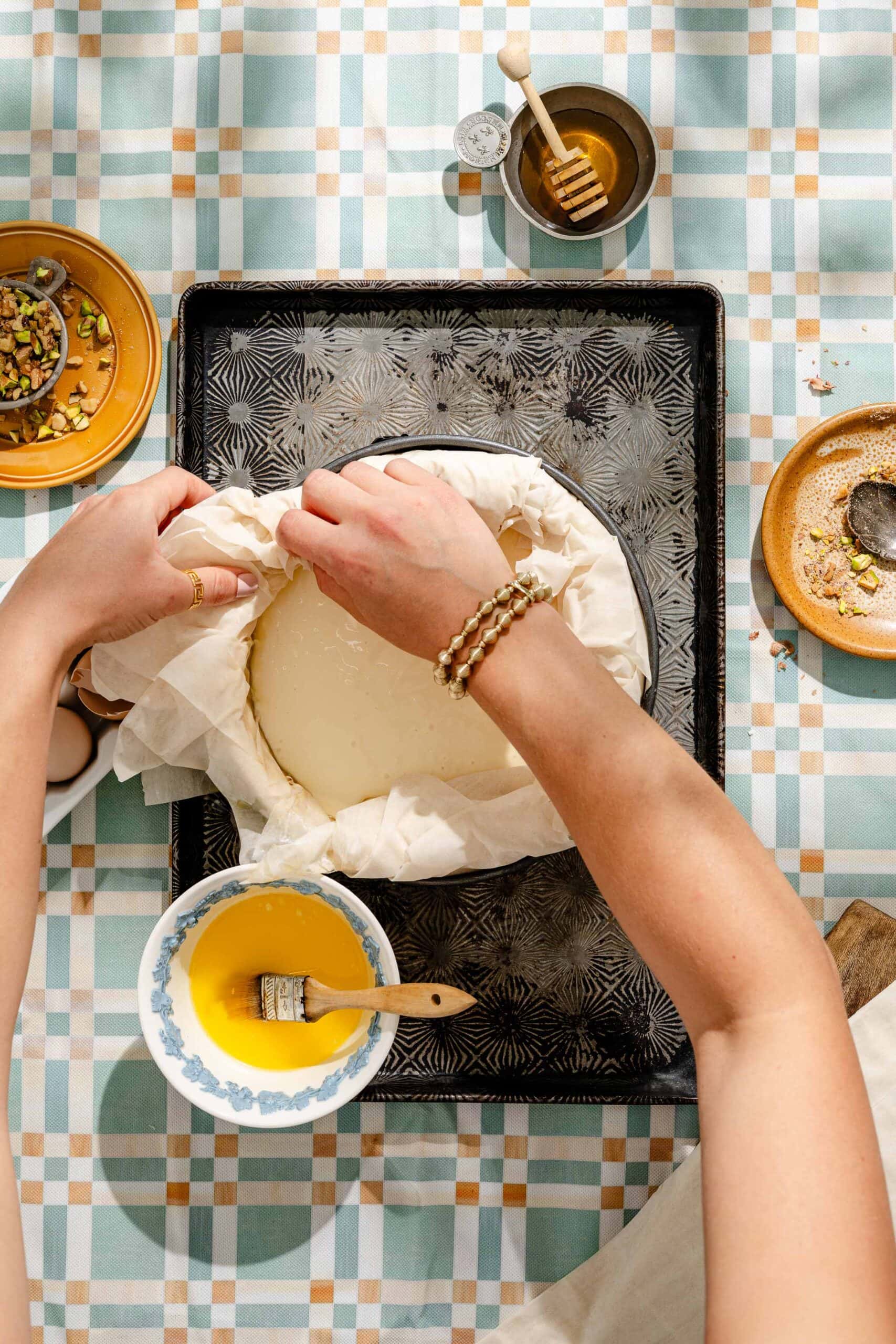
The overhanging phyllo is brought up around the filling and gently scrunched into a golden border. This is not meant to look perfectly uniform, so don’t stress if it doesn’t look perfect.
The most important baking cue? The center should have only a slight jiggle when it comes out of the oven. Cheesecake continues setting as it cools, so waiting until the entire center is firm while baking can lead to a drier texture and more cracking.
My Bougatsa (Greek Custard Pie) is another beautiful dessert to make next.
Tips for THE perfect edge & Center
Keep the phyllo covered
The problem: Your phyllo sheets dry out, tear, or become difficult to layer.
The fix: Keep unused, thawed phyllo sheets under a slightly damp towel while you assemble the cheesecake.
Why it works: Phyllo dries quickly when exposed to air. A towel that is slightly damp (not wet) helps protect the sheets so they stay flexible enough to layer without becoming brittle.
Do not rush the room-temperature ingredients
The problem: The filling feels difficult to mix smoothly, leading to more aggressive mixing.
The fix: Make sure the cream cheese, labneh, and eggs are at room temperature before you begin.
Why it works: Room-temperature ingredients blend together more easily, which means the filling comes together with less mixing. Scrape down the bowl as needed and stop once the eggs are incorporated.
Trust the slight jiggle
The problem: You are waiting for the cheesecake center to look completely firm before removing it from the oven.
The fix: Look for a cheesecake that is set around the outside with a slight movement in the center, exactly as the recipe card specifies.
Why it works: The cheesecake will continue to set as it cools. A fully rigid center in the oven is not the goal and can affect the final creamy texture.
Cool before chilling
The problem: Removing the springform ring too soon.
The fix: Let the cheesecake cool in the pan on a rack for one hour, then refrigerate for at least two hours or overnight before removing the ring.
Why it works: Cooling is part of the setting process. Giving the filling time to firm up helps you get clean slices while keeping that creamy center.
My Portokalopita (Greek Orange Phyllo Cake) is another FoodByMaria phyllo dessert worth baking.
Serving and Storage
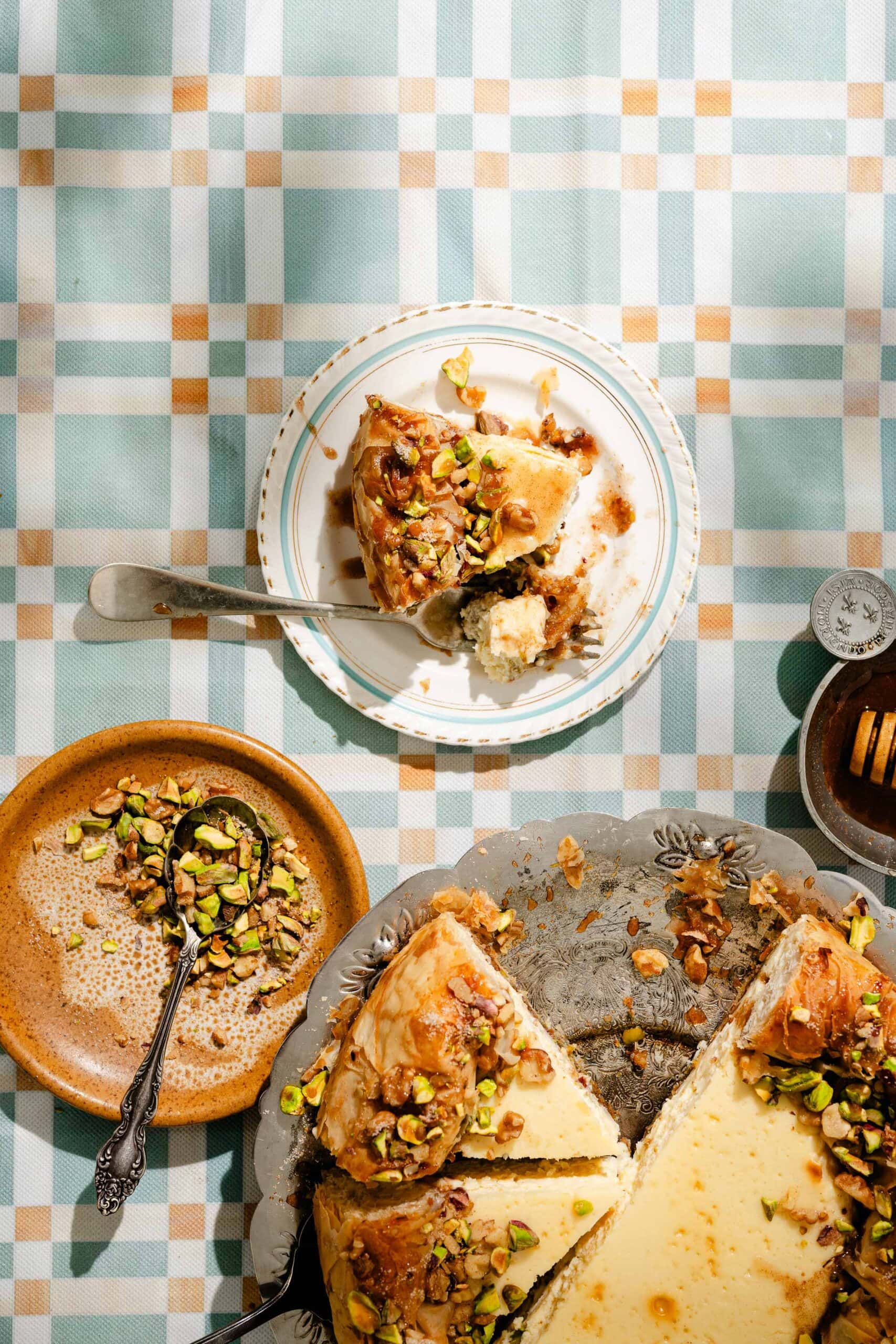
This baklava cheesecake recipe makes 10–12 pieces, making it the perfect dessert when hosting. Once chilled, drizzle the cinnamon honey around the phyllo edge and sides and use the reserved nut mixture to sprinkle all around it.
Store the covered cheesecake in the refrigerator for up to four days.
If you are planning a full dessert spread, check out my guide to Best Greek Desserts: From Baklava to Loukoumades for more sweet ideas.
FAQs
Baklava cheesecake is a baked cheesecake that takes its flavor and texture cues from baklava. This version has a cream cheese and labneh filling, buttered phyllo pastry, pistachios, walnuts, cinnamon, cardamom, and cinnamon honey.
Bake the cheesecake until the center has a jiggle, as specified in the recipe card. The outer portion should look set, while the middle still moves gently. It will continue setting during the one-hour room-temperature cooling period and the refrigeration time, so do not wait for the center to become completely rigid in the oven.
Store leftover cheesecake covered in the refrigerator for up to four days. For the best contrast between the creamy filling and the phyllo edge, follow the recipe card’s finishing instructions with the cinnamon honey and reserved nut mixture before serving.
Save this recipe for later
Watch the Video
Ingredients
For the cheesecake filling
- 450 grams cream cheese, at room temperature
- ½ cup labneh, room temperature
- ¾ cup granulated sugar
- 1 tbsp cornstarch
- 1 tbsp vanilla extract
- 2 tsp fresh squeezed lemon juice
- 2 large eggs, room temperature
For the baklava crust
- 10 sheets phyllo pastry, defrosted if frozen, divided
- 2 sticks butter (227 grams), melted
- ¾ cup finely chopped salted pistachios
- ¾ cup finely chopped unsalted walnuts
- 1 tsp ground cinnamon
- ¼ tsp ground cardamom
- ¼ cup granulated sugar
For the spiced honey
- ½ cup honey
- 1 tsp ground cinnamon
Instructions
Start Cooking- Make sure the cream cheese, eggs and labneh are at room temperature before starting.
- Make the cheesecake filling: In a mixing bowl use a hand mixer (or stand mixer with paddle attachment), starting on medium-low speed and increasing to medium-high, to beat the cream cheese with the labneh, sugar and cornstarch until fluffy, about 1-2 minutes, scraping down the sides of the bowl as needed. Add the vanilla extract and lemon juice and beat until well-combined. Finally, add the eggs and beat until well combined. Set aside.
- Preheat the oven to 325F.
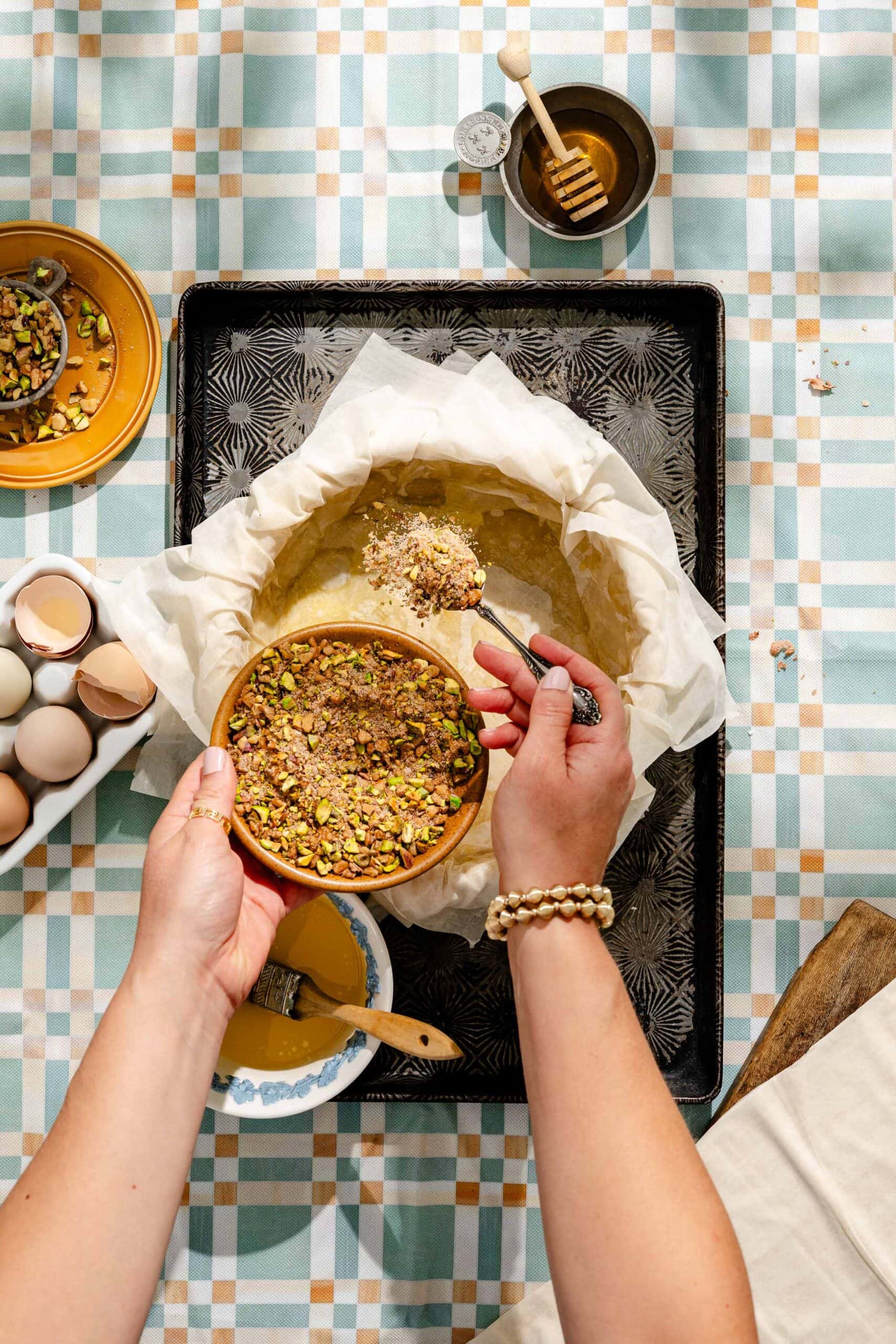
- Make the nut filling: In a medium bowl mix together the finely chopped pistachios, finely chopped walnuts, ground cinnamon, ground cardamom and sugar until well combined. Set aside ¼ cup of the filling in a small bowl and keep the rest in the medium bowl.
- Place a 9-inch springform pan on a baking sheet.
- Keep the defrosted phyllo pastry under a slightly damp towel to avoid the pastry drying out while assembling the cake.
- Melt the butter and then brush the base and the sides of the springform pan with melted butter.
- Layer a sheet of phyllo on the bottom of the pan (the phyllo will go up the sides of the pan a bit and over the edge of the pan as you layer). Then, brush the bottom and sides of the phyllo sheet with melted butter. Make 6 more layers, rotating each phyllo sheet slightly as you layer for full coverage of the pan, brushing with butter each time for a total of 7 layers of phyllo.
- After you’ve brushed the seventh sheet of phyllo with melted butter, spread the nut mixture from the medium bowl in a single layer on the phyllo.
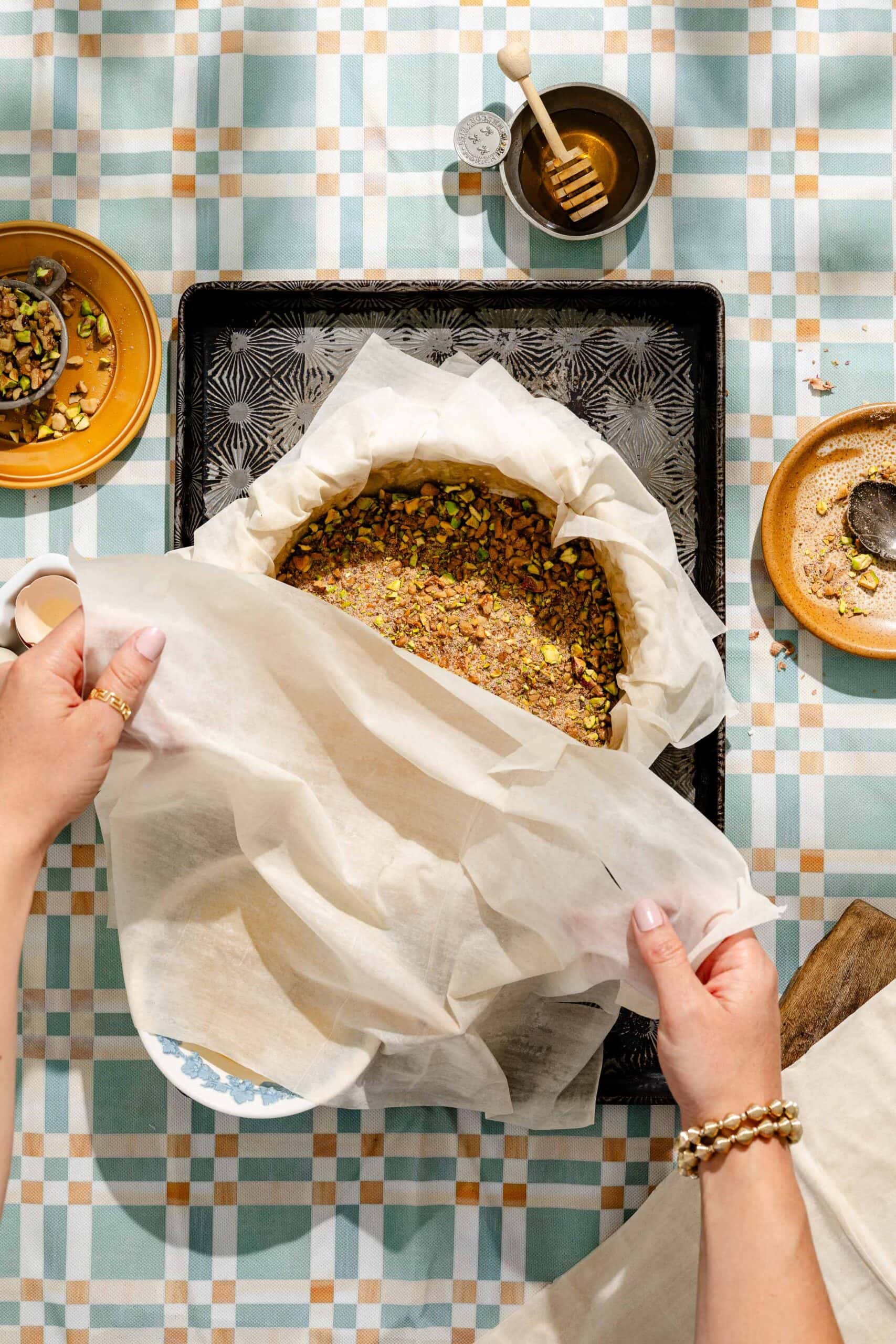
- Layer a sheet of phyllo over the nut filling and brush with butter. Repeat with two more phyllo sheets, rotating each phyllo sheet slightly as you layer for full coverage of the pan, brushing each with butter before laying the next for a total of 3 phyllo layers.
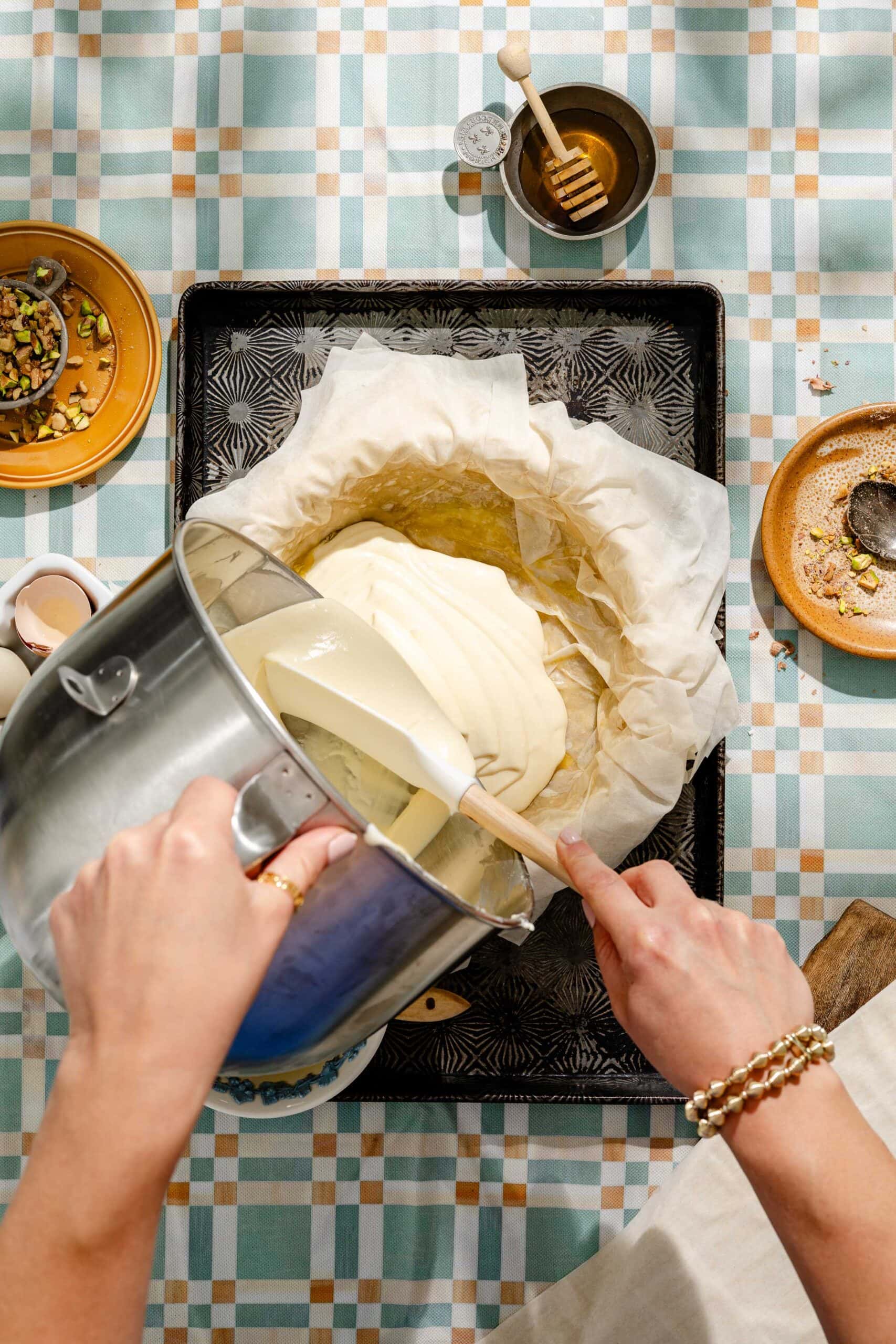
- Pour the cheesecake mixture into the center of the pan, over the phyllo layers and use an offset spatula to smooth out the top of the filling in an even layer.
- Bring the edges of the phyllo that were hanging over the edge of the pan up and into the baking pan, scrunching the phyllo along the circumference of the pan so you get a crinkled crust, about 1 ½ – 2 inches wide and you can still see the center of the cheesecake. Brush the phyllo ‘crust’ around the edges of the pan with any leftover butter, getting in the crevices where you can..
- Bake the baklava cheesecake on the sheet pan for 60-70 minutes on the center rack of the oven, until the cheesecake has just a slight jiggle in the center. Remove the cake from the oven and let cool in the cake pan on the sheet pan, on a cooling rack for one hour at room temperature.
- Then finish cooling the cheesecake in the fridge for at least 2 hours before removing the springform ring. (You can cool this cheesecake overnight if made ahead of time – as it cools the filling will become more firm).
- Before serving, make sure the springform ring has been removed. Then, whisk together the honey and ground cinnamon until combined. Drizzle about half of the honey mixture around the edges of the crust of the cake and along the sides of the cake. Then sprinkle the reserved nut mixture all around the edges of the crust and finish by drizzling the rest of the honey.
Notes
- Store this cake in the fridge for up to 4 days.
- If you love the flavors of baklava, you’ll love our Baklava Cake

9 people are discussing this recipe. Join in
Great recipe
Thank you so much, Ellie!!!
Possibly the best dessert I’ve ever made!! So simple to follow and such a show stopper – everyone is still raving about it !
You are so sweet, Cora! Thank you so much.
This recipe was so good! Not complicated to make, but looks very impressive, and tastes amazing. My whole family can’t stop raving about it!
ABSOLUTELY DELICIOUS!
I’m so excited to try and make this but before I get started can ricotta be the substitute for the labneh?
We didn’t test it like that but it should work!!
Will definitely make again!