
This post may contain affiliate links. Please read our disclosure policy.
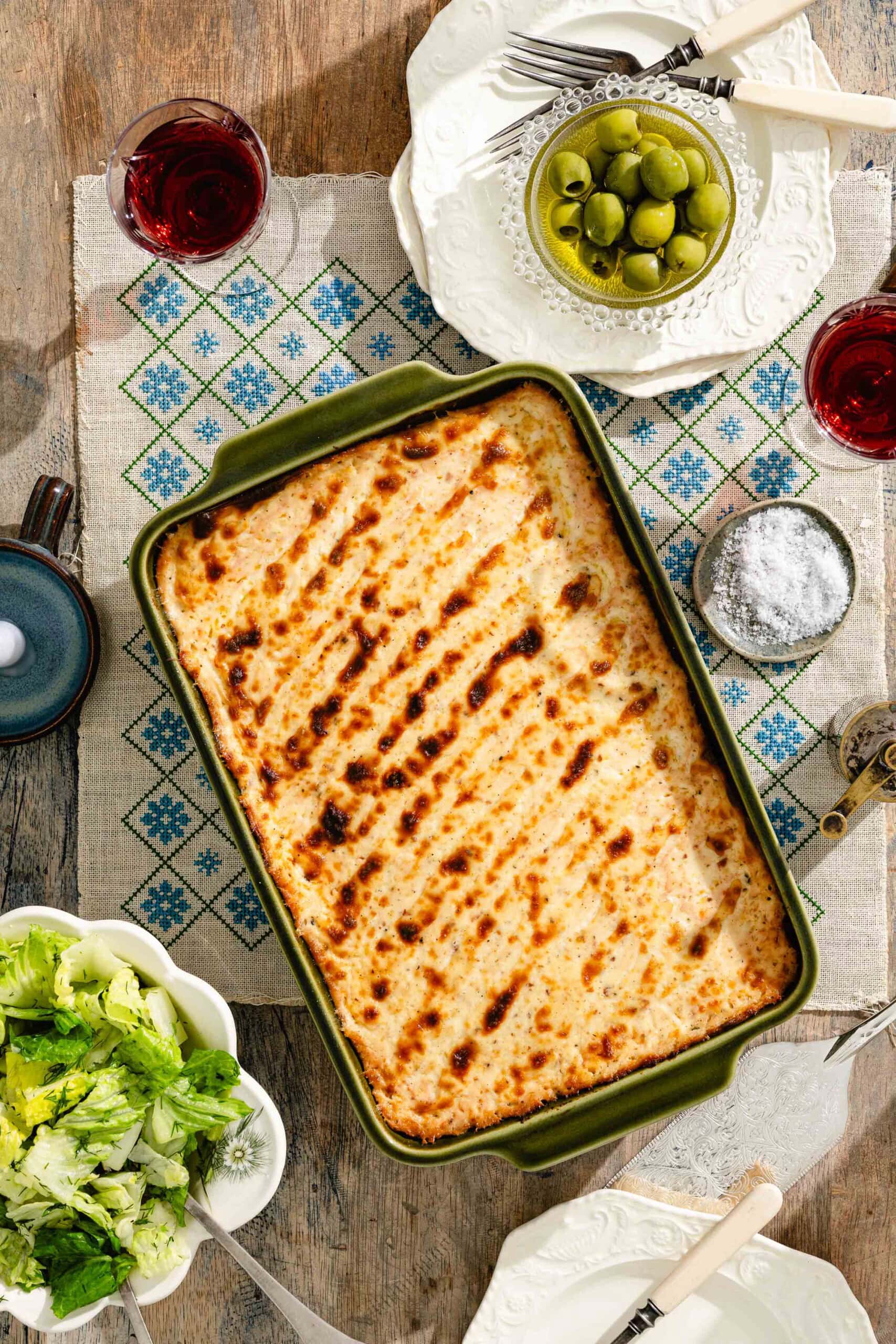
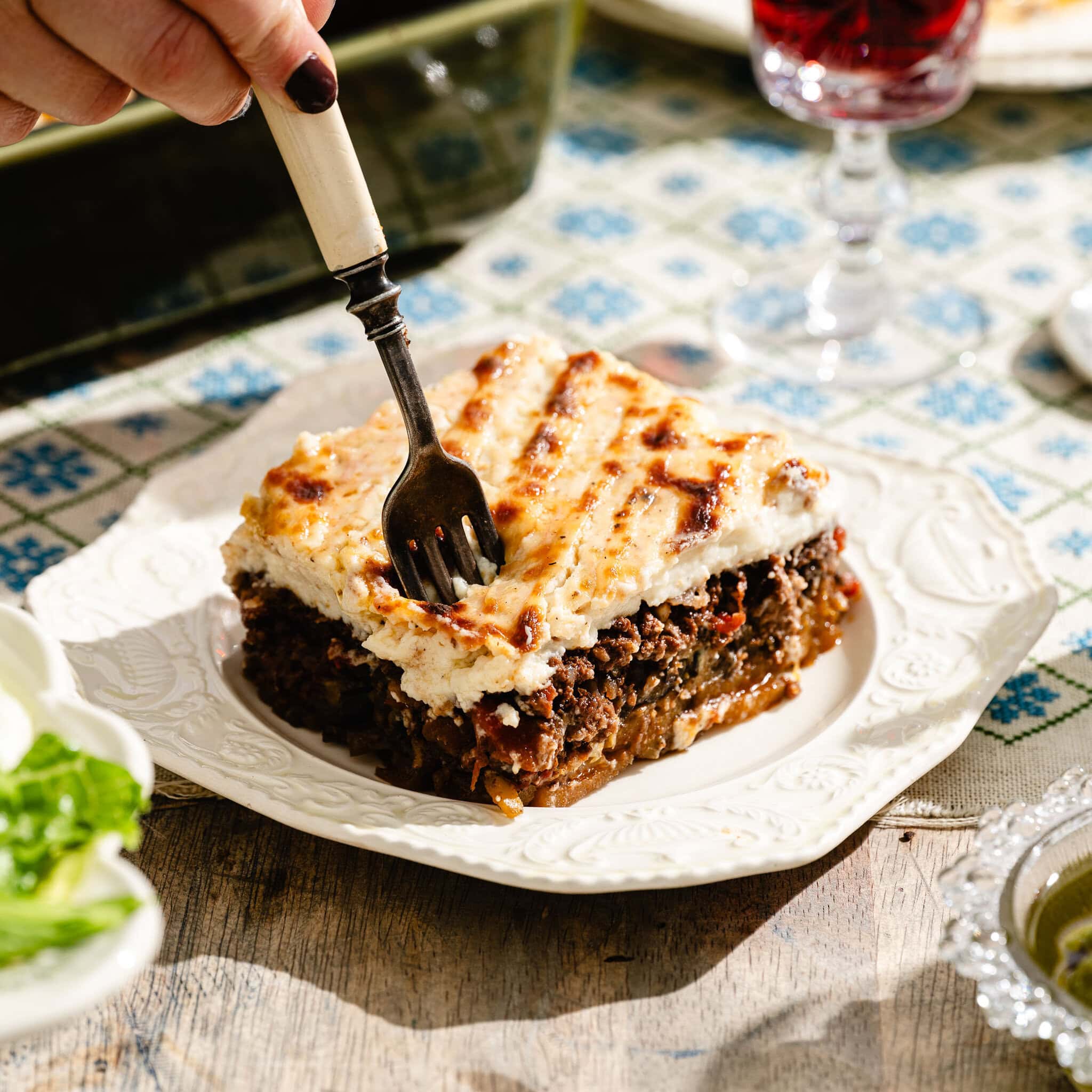
This Moussaka Recipe is a classic layered Greek casserole made with baked eggplant, spiced beef, potatoes, and a creamy béchamel, baked until golden. It’s the kind of dish I grew up eating for a comforting Sunday meal that filled the whole house with the scent of cinnamon and cloves. This Greek moussaka recipe brings together three simple components that transform into something that is so nostalgic and delicious.
Why You’ll Love This Moussaka Recipe
- Traditional and authentic: This is the moussaka recipe I grew up eating… layers of baked eggplant, warmly spiced beef, golden potatoes, and creamy béchamel, just like yia-yia made it.
- Three simple components, one unforgettable dish: Eggplant and potatoes, a cinnamon-and-clove-spiced meat sauce, and a rich, creamy béchamel.
- Feeds a crowd: One 9×13 pan makes 8 generous pieces. Perfect for Sunday dinners, holidays, or anytime you want a meal that brings people to the table.
- Even better the next day: The flavors meld overnight, making leftovers arguably the best part of this moussaka recipe.
What Is Moussaka?
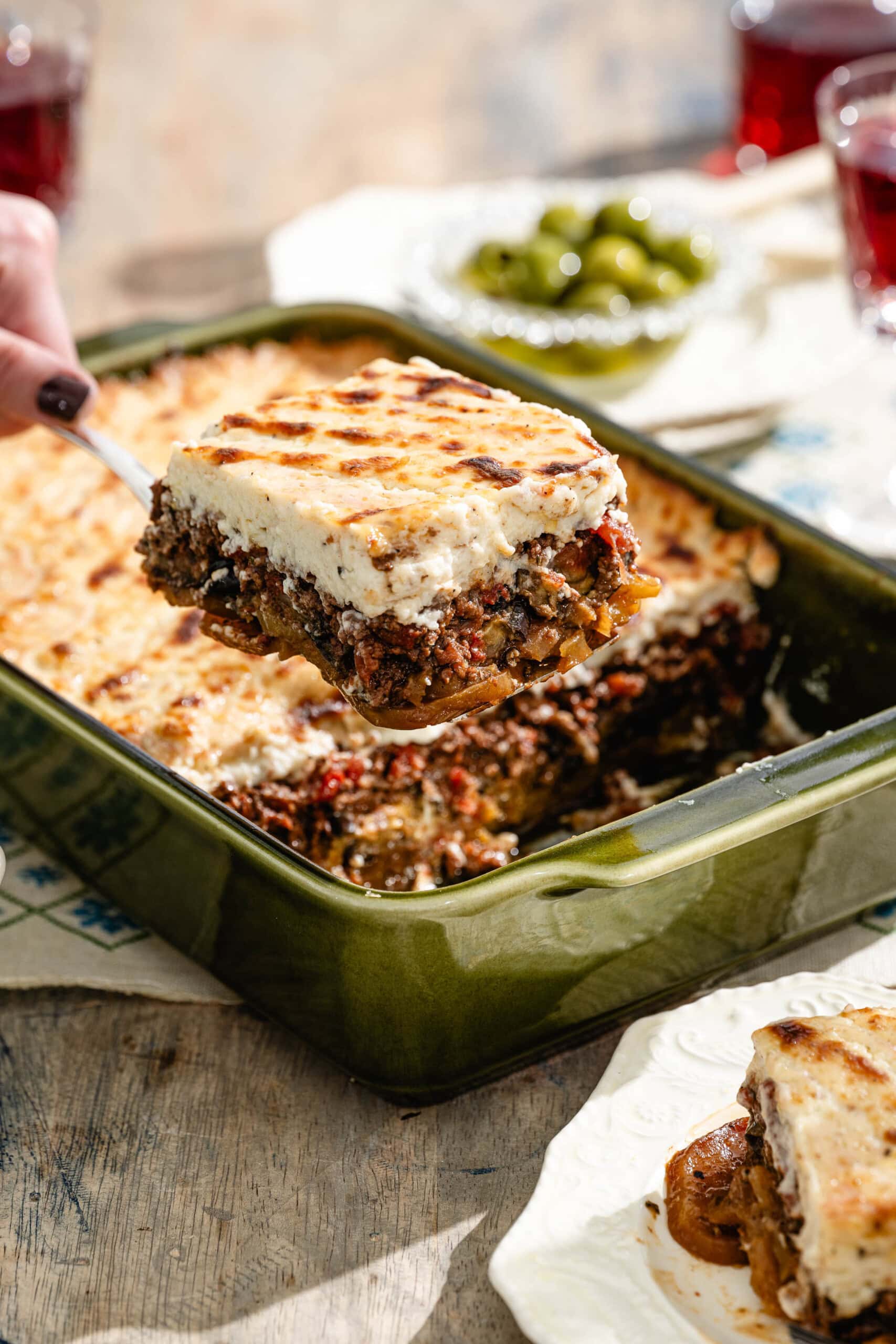
Moussaka is a traditional Greek baked casserole made with layers of eggplant, a spiced meat sauce, and a thick béchamel topping. It’s considered one of Greece’s most iconic dishes, right alongside pastitsio and spanakopita, and a cornerstone of traditional Greek food.

Maria Koutsogiannia
Maria is the creator of FoodByMaria and your go-to Greek food expert for cozy, flavor-packed recipes. Inspired by her Mediterranean roots, she brings traditional Greek flavors, feel-good ingredients, and a whole lot of joy to everyday cooking.
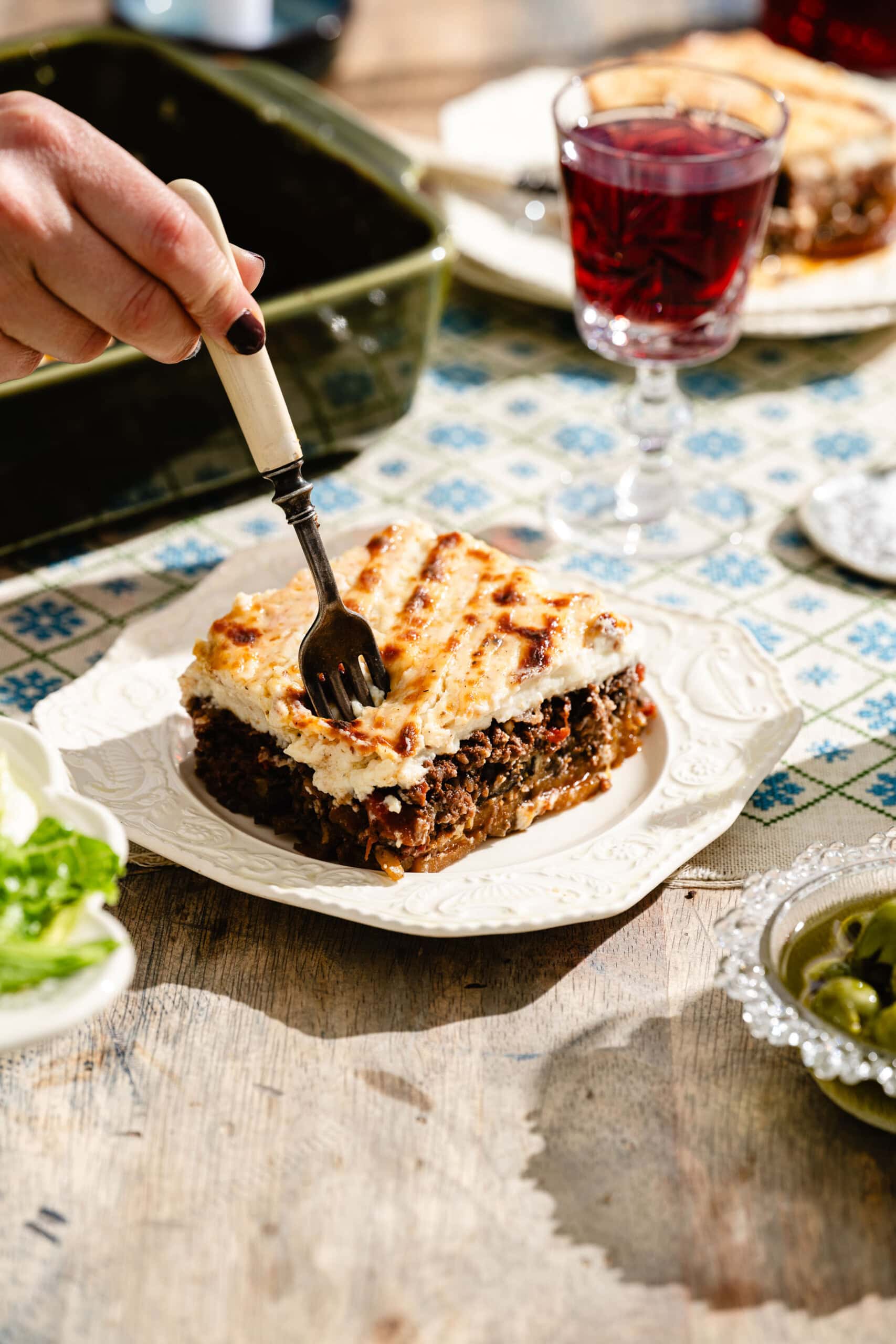
At its core, moussaka is built from three layers: tender baked eggplant (and often potatoes), a rich meat sauce known as kima, and a creamy egg-based béchamel. When baked, the top turns golden while the inside stays soft, rich, and perfectly layered.
The modern version we know today was popularized in the 1920s by chef Nikolaos Tselementes, though variations of eggplant-and-meat dishes have existed across the Eastern Mediterranean for centuries. You’ll often hear it called “Greek lasagna,” and while the layered idea is similar, eggplant moussaka swaps pasta for vegetables and builds flavor with warming spices like cinnamon, cloves, and allspice (vs. Italian herbs).
Key Ingredients
This moussaka recipe is all about three components coming together to make the most perfect Greek dish. Here’s what makes each one special:
Eggplant and Potatoes
- Eggplant: Three medium eggplants sliced into rounds and salted before baking. This step draws out excess moisture through osmosis and removes bitterness, giving you silky, golden slices instead of soggy ones. This is key for a perfect moussaka.
- Potatoes: A layer of thinly sliced yellow potatoes forms the base, soaking up the juices from the meat sauce and helping the dish hold its structure.
- Parmesan cheese: Just a sprinkle between layers adds a salty, umami boost.
Love eggplant? Try our melitzanosalata (whipped eggplant dip).
The Meat Sauce (Kima)
- Lean ground beef: The classic choice, though lamb is also traditional.
- Red wine: Adds depth and richness while deglazing the pan.
- The warming spice trio: Cinnamon, cloves, and allspice; this is what sets a moussaka recipe apart from Italian-style sauces. It’s cozy, aromatic, and unmistakably Greek.
- Tomatoes, basil, bay leaves, and tomato paste: Build a rich, balanced sauce.
- A touch of sugar: Just enough to balance acidity.
The Béchamel
- Egg-enriched béchamel: Two eggs are tempered into the sauce, giving it a custardy texture that sets beautifully when baked.
- Nutmeg: A classic finishing spice that adds warmth.
- Cheese: Traditionally mizithra (μυζήθρα), a tangy sheep’s milk cheese. Parmesan works perfectly as a substitute.
Tips for the Best Moussaka
- Salt the eggplant. This removes moisture and prevents soggy layers in your moussaka.
- Bake instead of fry. Eggplant absorbs oil like a sponge, so baking keeps things lighter while still golden.
- Cook the meat sauce until thick. A watery sauce leads to a watery moussaka; let it reduce properly.
- Temper the eggs for the béchamel. Whisking hot sauce into the eggs first prevents scrambling and gives that smooth, custardy finish.
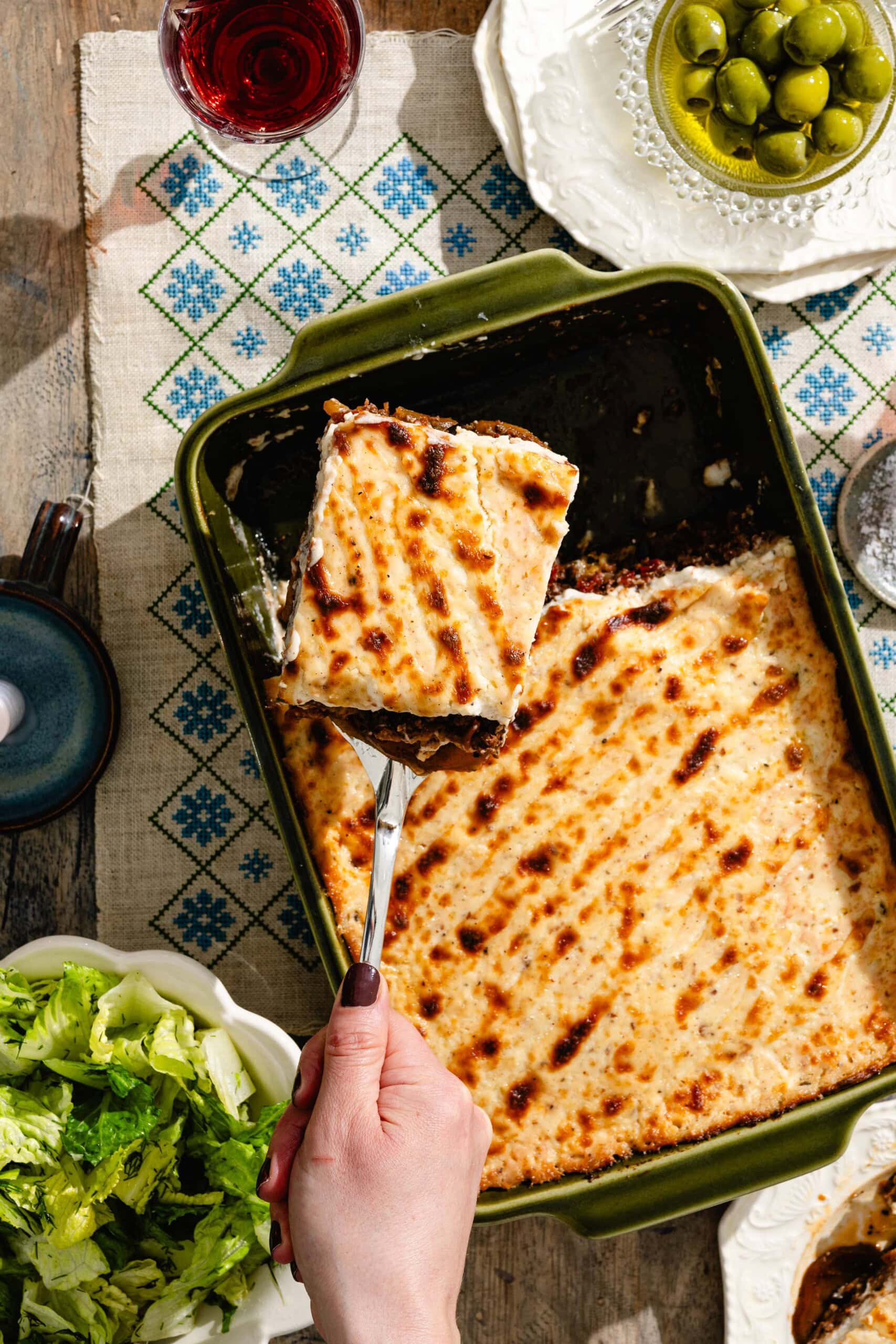
- Let it rest for a full hour. This is non-negotiable. It allows the layers of the moussaka to set so you get clean slices.
- Adjust the olive oil to taste. Traditional versions often use more for extra richness.
- No red wine? Beef broth works just fine as a substitute.
Variations
- Lamb or lamb-beef blend: Swap the beef for lamb or use a mix for a richer flavour.
- Chicken or turkey: A lighter option that still works beautifully with the spices.
- Add zucchini: Layer it alongside the eggplant for extra veg.
- Potato-only or eggplant-only: Both versions are traditional in different parts of Greece.
- Plant-based version: Try our plant-based summer moussaka
What to Serve with Moussaka
Moussaka is rich and hearty, so it pairs best with lighter, fresh sides. Think of it as the centrepiece of a relaxed Sunday spread.
- Greek salad
- Warm pita bread
- Tzatziki sauce
- Simple green salad with lemon and olive oil
- Olives and feta as a pre-dinner snack
If you love eggplant, also try our papoutsakia (Greek stuffed eggplant).
How to Store and Reheat Moussaka
Make-ahead: Assemble the moussaka completely and refrigerate unbaked for up to 24 hours. Add extra bake time since it’ll be cold going in.
Refrigerator: Store in an airtight container for up to 4 days. The flavour actually gets better overnight.
Freezer: Freeze portions or the whole dish (wrapped well) for up to 3 months.
Reheating: Cover with foil and bake at 350°F for 20–25 minutes, or microwave individual portions for 2–3 minutes.
FAQ
Moussaka is a layered Greek casserole made of baked eggplant, potatoes, a warmly spiced ground beef sauce (kima) seasoned with cinnamon, cloves, and allspice, and a thick egg-enriched béchamel sauce. Everything is layered in a baking dish and baked until golden brown.
They share a similar layered concept, but moussaka uses eggplant and potatoes instead of pasta. The flavor is completely different, with warming spices instead of Italian herbs, and a custardy béchamel instead of ricotta.
Traditionally, mizithra is used, a slightly tangy sheep’s milk cheese. Parmesan is the most common substitute.
Standard globe eggplants work best. Look for firm, heavy eggplants with smooth skin for the best texture.
Yes! Assemble it fully and refrigerate it up to 24 hours before baking, or freeze it for longer storage.
The béchamel needs time to set. Resting for at least an hour ensures clean, structured slices instead of a runny dish.
Save this recipe for later
Watch the Video
Ingredients
For the eggplant and potatoes
- 3 medium eggplants, sliced into 1/3 inch rounds
- 6 large yellow potatoes, sliced into 1/4 inch rounds
- olive oil
- salt and pepper
- 2 tbsp shredded parmesan cheese
For the meat sauce
- 1 ½ tbsp olive oil
- 2 white onions, diced
- 1 ½ lbs lean ground beef
- 4 garlic cloves, minced
- ½ cup red wine
- 2 ½ tsp salt
- 1 tsp ground pepper
- 1 tsp ground cinnamon
- ¼ tsp ground cloves
- 1 tbsp dried basil
- ¾ tsp ground all spice
- 3 bay leaves
- 2 ¾ cups diced or whole canned tomatoes
- ½ tbsp sugar
- 1 tbsp tomato paste
- 1 cup water
For the bechamel
- 2 large eggs
- 6 tablespoons unsalted butter
- ⅔ cup all-purpose flour
- 6 cups whole milk, room temperature
- 1 ½ teaspoons kosher salt
- ½ teaspoon freshly ground black pepper
- ¼ teaspoon ground or freshly grated nutmeg
- ½ cup freshly grated Parmesan cheese (or mizithra cheese)
Instructions
Start CookingPrepare the eggplant and potatoes
- Preheat the oven to 375F. Generously grease 2 large non stick sheet pans with olive oil. Set aside.
- Prepare the eggplant: Slice the eggplant into 1/3 inch slices. Put the slices in a large bowl with a big pinch of salt and let sit for 10 minutes.
- While the eggplant sits, prepare the potatoes. Peel and then cut the potatoes into 1/4 inch slices. Place the potato slices on one of the prepared sheet pans (or two if needed) and only slightly overlap them. Drizzle generously with olive oil and and an even layer of salt and pepper. Place in the oven for 15 minutes.
- Once the eggplant slices have sat in the water for 10 minutes, drain and gently pat dry. Add the eggplant slices to the other oiled sheet pan, the slices can just overlap. Drizzle generously with olive oil and and an even layer of salt and pepper. Once the potatoes have been in the oven for 15 minutes, add the eggplant to the oven and bake everything for 35-40 more minutes until the eggplant is golden brown.
- Remove the potatoes and eggplant from the oven and set aside.
Make the meat sauce
- While the potatoes and eggplant are baking, make the meat sauce.
- Add the olive oil to a large pot over medium-high heat. Add the diced onions, beef and garlic. Break up the beef with a spoon into small pieces and cook with the lid on, stirring every 3 minutes, until there are no juices left, about 12-15 minutes.
- Pour in the red wine to deglaze. Cook for a few minutes with the lid off until most of the wine has evaporated.
- Stir in the spices and bay leaves. Stir in the diced or whole tomatoes (if using whole tomatoes crush them up a bit when added to the pot), sugar, tomato paste and water and bring to a boil over high heat. Once simmering, turn to medium low and simmer with the lid on until the sauce has cooked down and most of the liquid has evaporated. Remove the bay leaves and set aside.
Make the bechamel
- While the meat sauce simmers, whisk the eggs well in a medium bowl.
- Melt the butter in a medium skillet or pot over medium-low heat. Add the flour and whisk constantly for 2 minutes. Continue to whisk as you stream in the milk, then add the salt, pepper, and nutmeg. Increase the heat to medium and bring the mixture to a simmer. Cook, whisking often, until slightly thickened, about 5 minutes. Remove the pot from the heat, add the cheese, and whisk until the sauce is uniform and creamy, 2 to 3 minutes.
- Transfer 1 cup of the béchamel sauce to a second medium bowl. Gradually whisk the eggs into the sauce in the bowl, then gradually whisk that mixture back into the sauce in the pot. Return the sauce to low heat and continue to cook, whisking occasionally, until it is even thicker and creamier, about 5 minutes.
Assemble the moussaka
- Preheat the oven to 375F. Grease an 9×13 baking dish with olive oil.
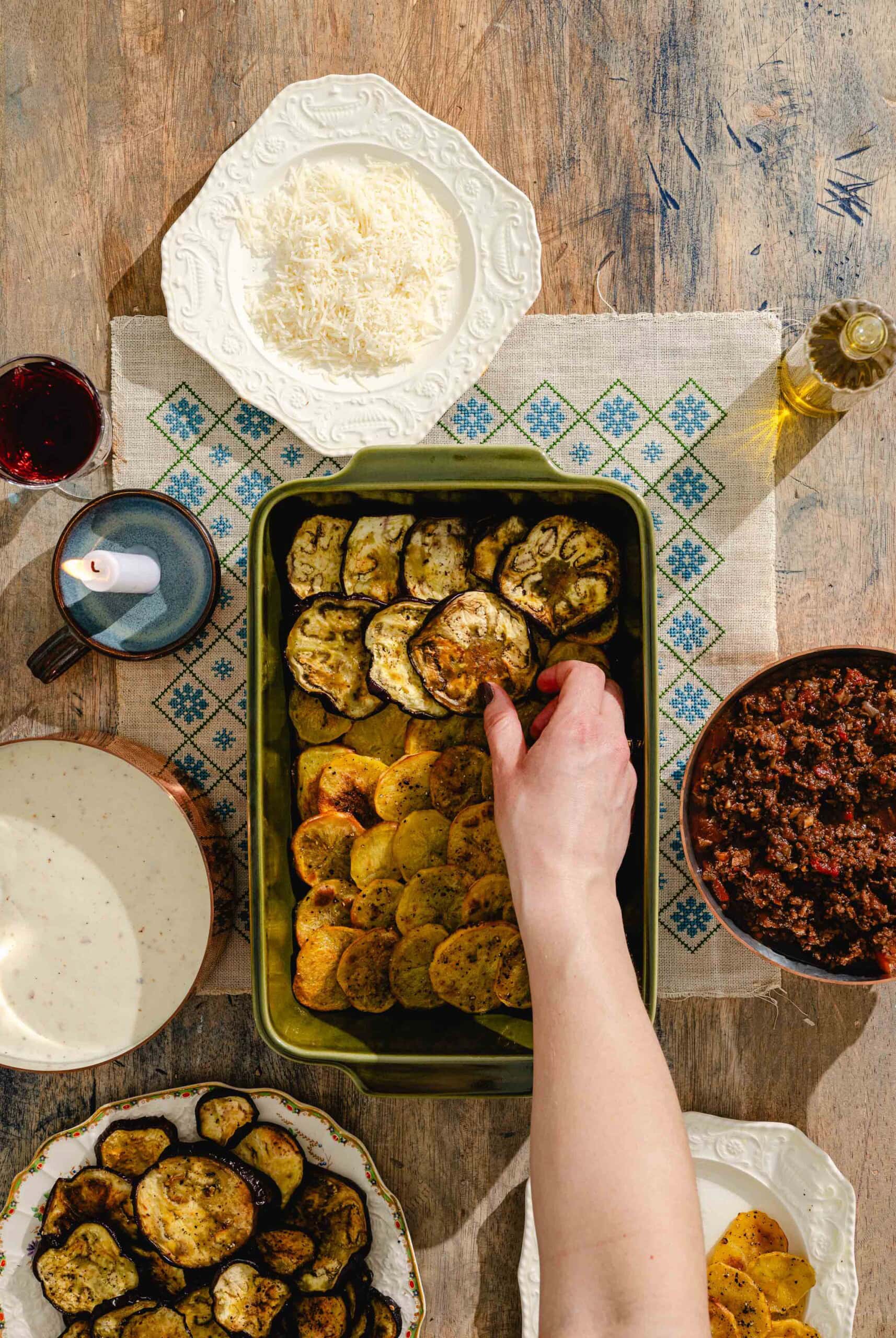
- Layer all of the cooked potato slices on the bottom of the baking dish, overlapping as you go until you have used all of the potato slices.
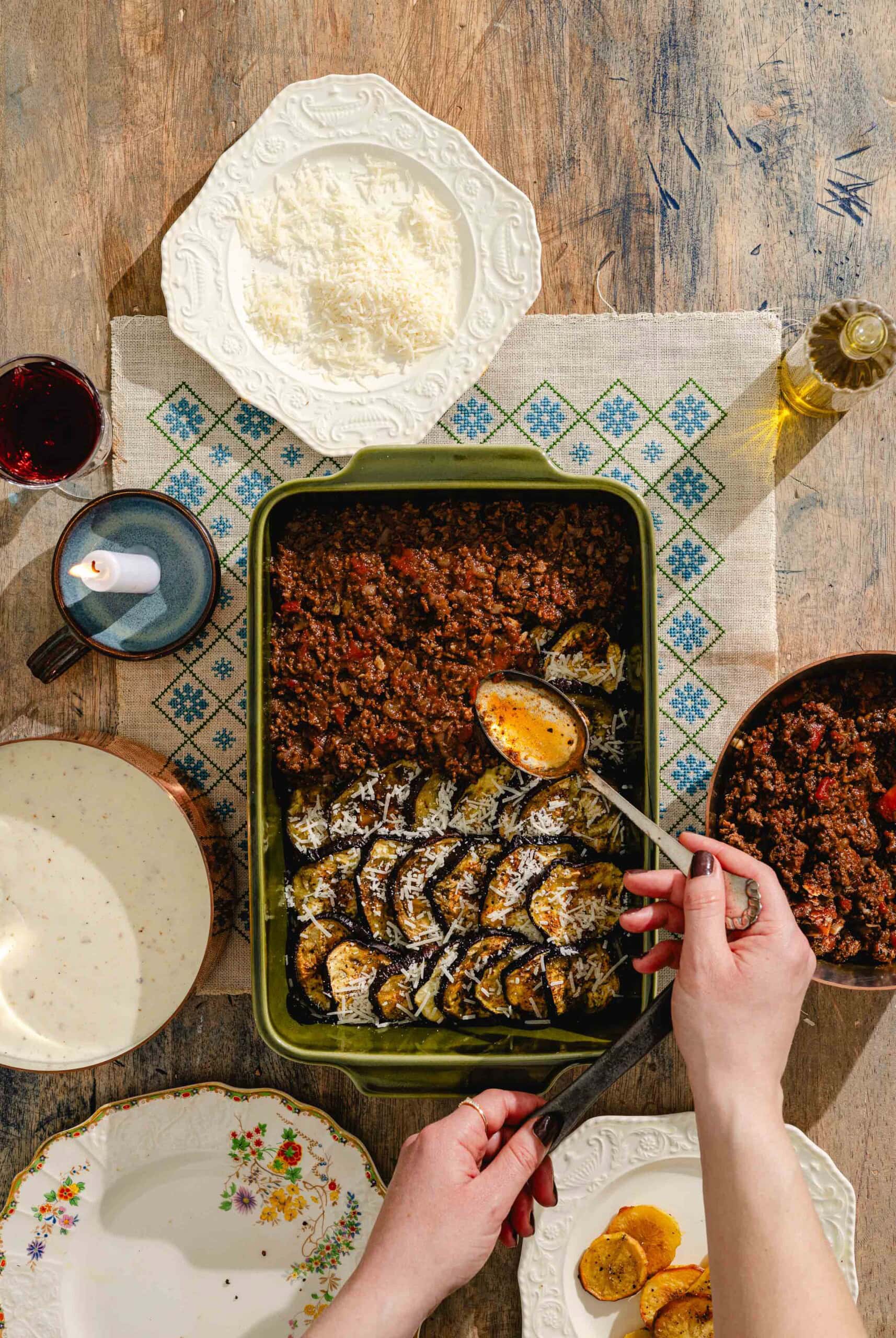
- Next layer all of the cooked eggplant slices, overlapping as you go until you have used all of the eggplant. Sprinkle 2 tbsp parmesan cheese over the eggplant layer.
- Pour in all of the meat sauce and spread evenly.
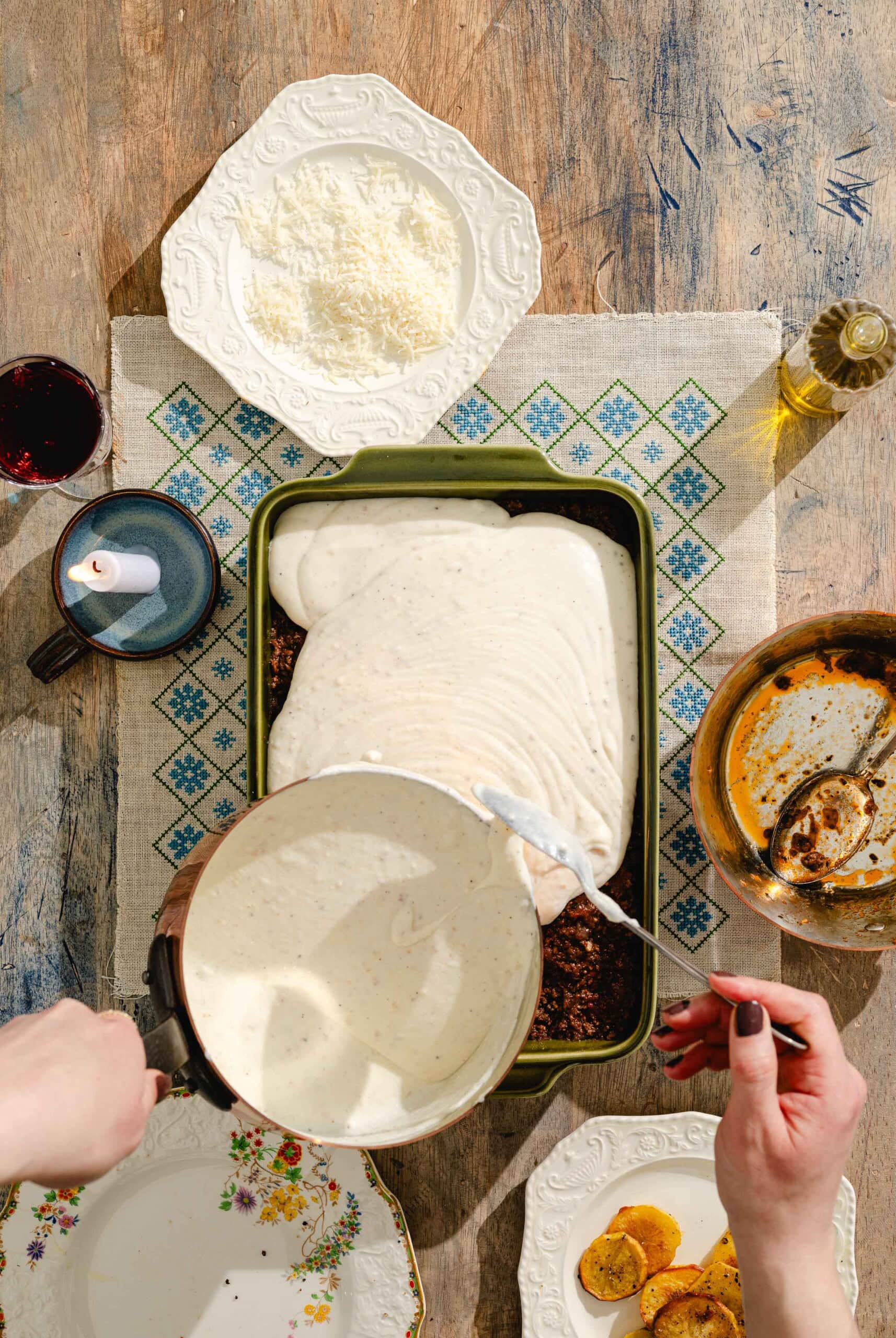
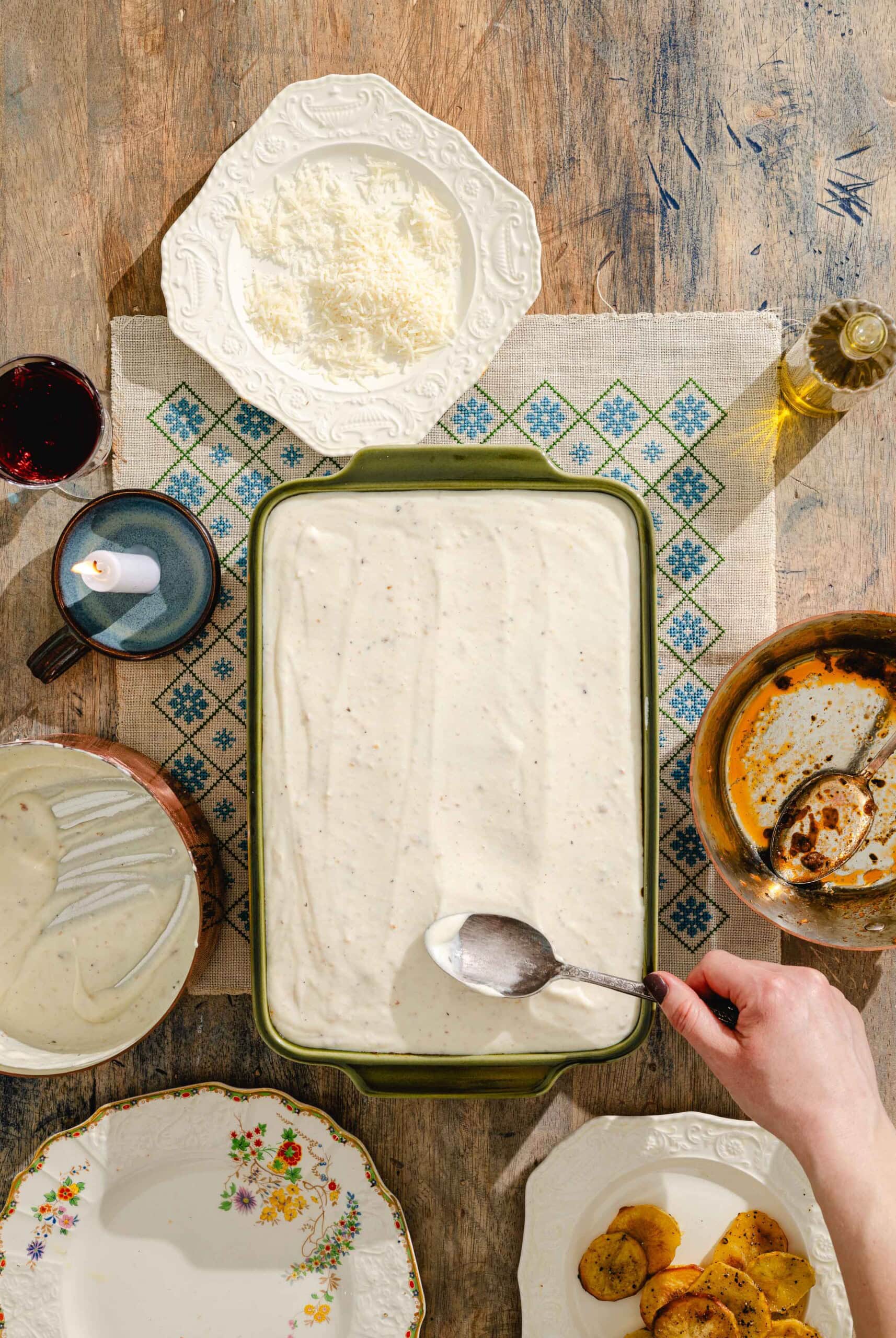
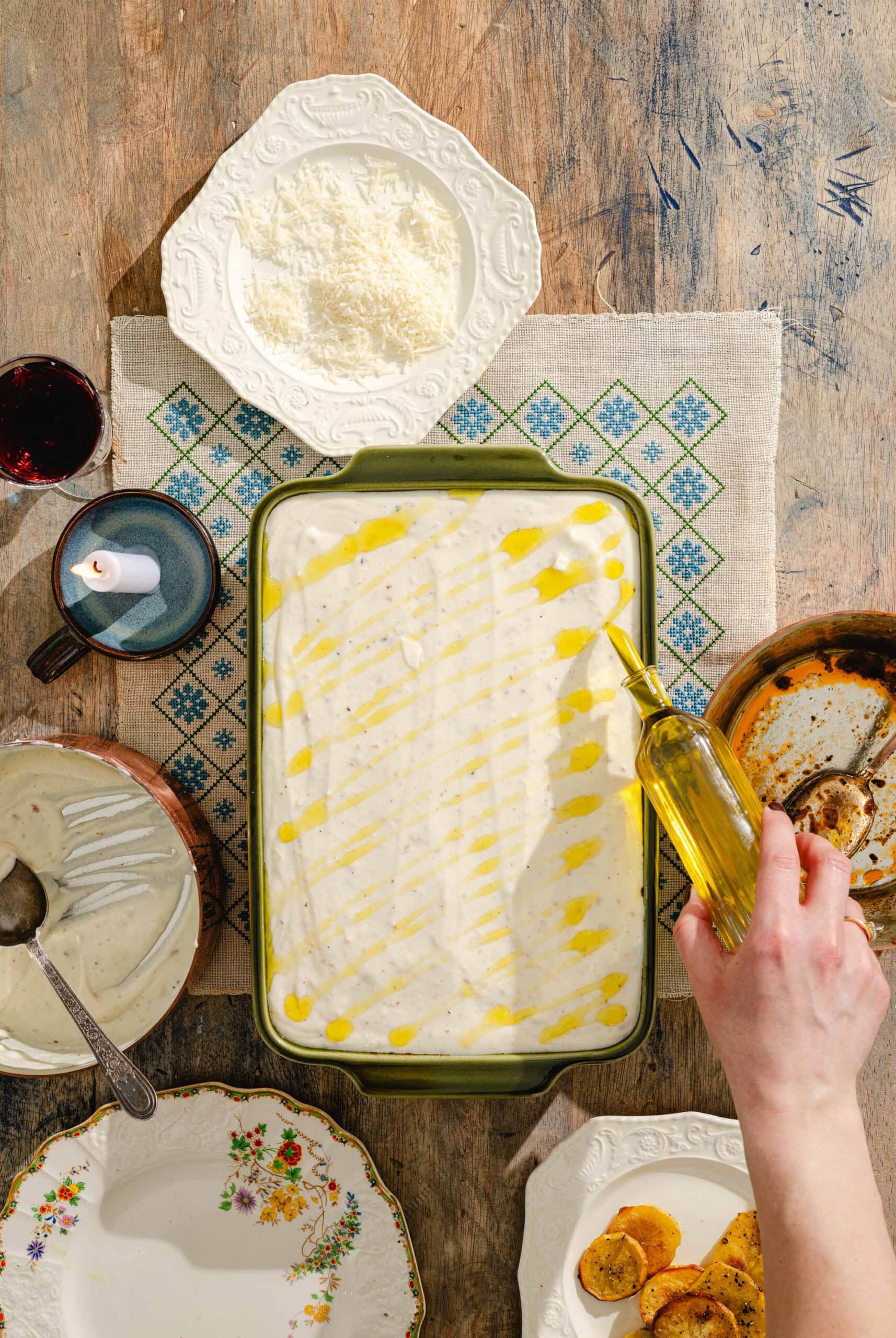
- Pour the bechamel on top of the meat sauce and spread is into an even layer.
- Drizzle the top with olive oil and bake in the middle of the oven until the top turns golden brown, about 40-45 minutes. Start checking around the 35 minute mark as all ovens cook differently.
- Remove from the oven and let cool at least an hour until it’s just warm, this will allow the bechamel layer to be fully set and stay together when you cut through the moussaka.
Notes
- Soaking the eggplant in water with salt removes some of the bitterness of the eggplant so don’t skip that step.
- Our meat sauce starts with 1 1/2 tbsp olive oil but in traditional Greek moussaka recipes the meat sauce can start with up to 1/2 cup olive oil so feel free to start the recipe with more olive oil if you prefer.
- For the meat sauce, if you don’t want to use red wine, you can try substituting with alcohol-free red wine or beef broth.
- If you love this recipe you’re sure to enjoy our Traditional Greek Pastitsio Recipe (Greek Lasagna)

29 people are discussing this recipe. Join in
Nice Recipe, thank you!
Nice Recipe, thank you!
I just had a Christmas party and every recipe I used aside from dessert (and even one of those!) was Maria’s. The moussaka was AMAZING. I’d never made it before but I’ve learned I can trust her recipes 100% and I’m never fearful that it won’t be yummy! It has a lot of steps, but it’s not hard. Just go through the recipe thoroughly before you start and it goes pretty smoothly. I doubled the recipe and it was nearly wiped out! So good.
WOW!! You are so sweet, thank you so much my love. Greek Mommy can always be trusted!!!
hi in the bechamel section it says 1/4 tsp ground nutmeg and then 1/8 tsp ground nutmeg – is the second one supposed to be another spice? thanks so miuch!
Sorry about that! 1/4 is corrrect!
Such a good recipe and easy to follow for a first timer!
Thank you so much, Dana!
This is so delicious, thank you for sharing your recipe. My first time eating and cooking moussaka! I made a few alterations to use up leftovers from the fridge and it was still sublime. Thank you, thank you, thank you.
Thank you so much!!!!!!
I am so looking forward to making this next week for a birthday dinner. Can I make it a day ahead and just put it in the oven to cook the day of the party? Will the potatoes and eggplant or zucchini (birthday girl doesn’t like eggplant) get mushy if it sits on the fridge? Would I be better off to keep all layers separate and assemble before baking? And if I use zucchini instead of eggplant do I follow the same steps of soaking in a salt bath, roasting for the same length of time as the eggplant?
I’ve been following you on IG for quite sometime. This will be the first of your recipes I make. Looking forward to it.
Hi Hunnie!!! Please assemble day off! You are better to get everything ready the night before and then put it together day off and bake! It will be pure magic!!!
Thank you so much for your reply. Will do that.
Just out of the oven and looks delicious
I am so excited for you!!!
So delicious!!
Thank you so much for the love, Aria!
What a delicious and beautiful meal!!! Coming from someone who grew up eating mainly Italian food and who still cooks that way, this moussaka was absolutely amazing! I like venturing off making dishes not typical of my Italian upbringing and trying something new. When I found “FoodByMaria” on IG, her recipes and videos made me want to try everything related to Greek cooking! So here I am, making moussaka and my own pita bread lol
The flavors in this dish are amazing, the potatoes, the eggplant, the meat and the bechamel sauce make this a meal your family will request often!!
My sons kept asking for more that is how delicious this dish was! Highly recommend and will definitely be making this again in the future!
you are so sweet, thank you so much Maria!!!