
This post may contain affiliate links. Please read our disclosure policy.
I can still hear the sound of olive oil hitting a hot pan in my mama’s kitchen. I can still picture my yia-yia’s hands moving effortlessly through sheets of phyllo, stretching, folding, brushing, and shaping something beautiful out of almost nothing. The smells, the sounds, the rituals, they’re stitched into my memory!
When people ask me what makes Greek food so special, I don’t think about recipes first. I think about ingredients, those Greek food staples.

Maria Koutsogiannia
Maria is the creator of FoodByMaria and your go-to Greek food expert for cozy, flavor-packed recipes. Inspired by her Mediterranean roots, she brings traditional Greek flavors, feel-good ingredients, and a whole lot of joy to everyday cooking.
Not because they were rare or expensive, but because they showed up every single day.
These seven ingredients weren’t just pantry staples. They were the building blocks of my childhood. Nearly every meal I grew up eating in Greece and in my family’s home could be traced back to some combination of them. They still show up in my kitchen on a daily basis and are part of my go-to recipes.

1. Extra Virgin Olive Oil (Elaiolado)
In my family’s kitchen, olive oil wasn’t a finishing touch.
It wasn’t something you bought in a fancy bottle and saved for special occasions.
It was everything. The most important Greek food staple.
We dipped bread into it, cooked vegetables in it, baked with it, dressed salads with it, and drizzled it over nearly every meal. There was never a question of whether olive oil belonged in a dish. The question was usually how much.
Growing up Greek means understanding that olive oil isn’t just an ingredient, it’s a way of life.
Every Greek family also believes, without question, that the best olive oil comes from their village. Mine is no different.
The olive oil I grew up with had a distinct peppery finish that would catch at the back of your throat. That little tingle? Greeks know it’s a good thing. It’s a sign of freshness and the naturally occurring polyphenols found in high-quality olive oil.
Most of the oils I grew up enjoying were made from Koroneiki olives, a variety known for producing intensely flavored oil with grassy, fruity, and peppery notes. That’s one reason Greek olive oil tastes different from many other styles.
And despite what you may have heard, Greeks absolutely cook with extra virgin olive oil. We roast with it, fry with it, bake with it, and finish dishes with it.
If you’re curious about the differences, I’ve shared more on Greek olive oil and how it compares in my guide to Greek vs. Italian olive oil. It’s also the star of my favorite bread dipping oil.
Shopping tip: Look for cold-pressed Koroneiki olive oil from Crete or the Peloponnese. I personally love single-origin, early-harvest oils from Messenia. And skip “light” olive oil entirely.
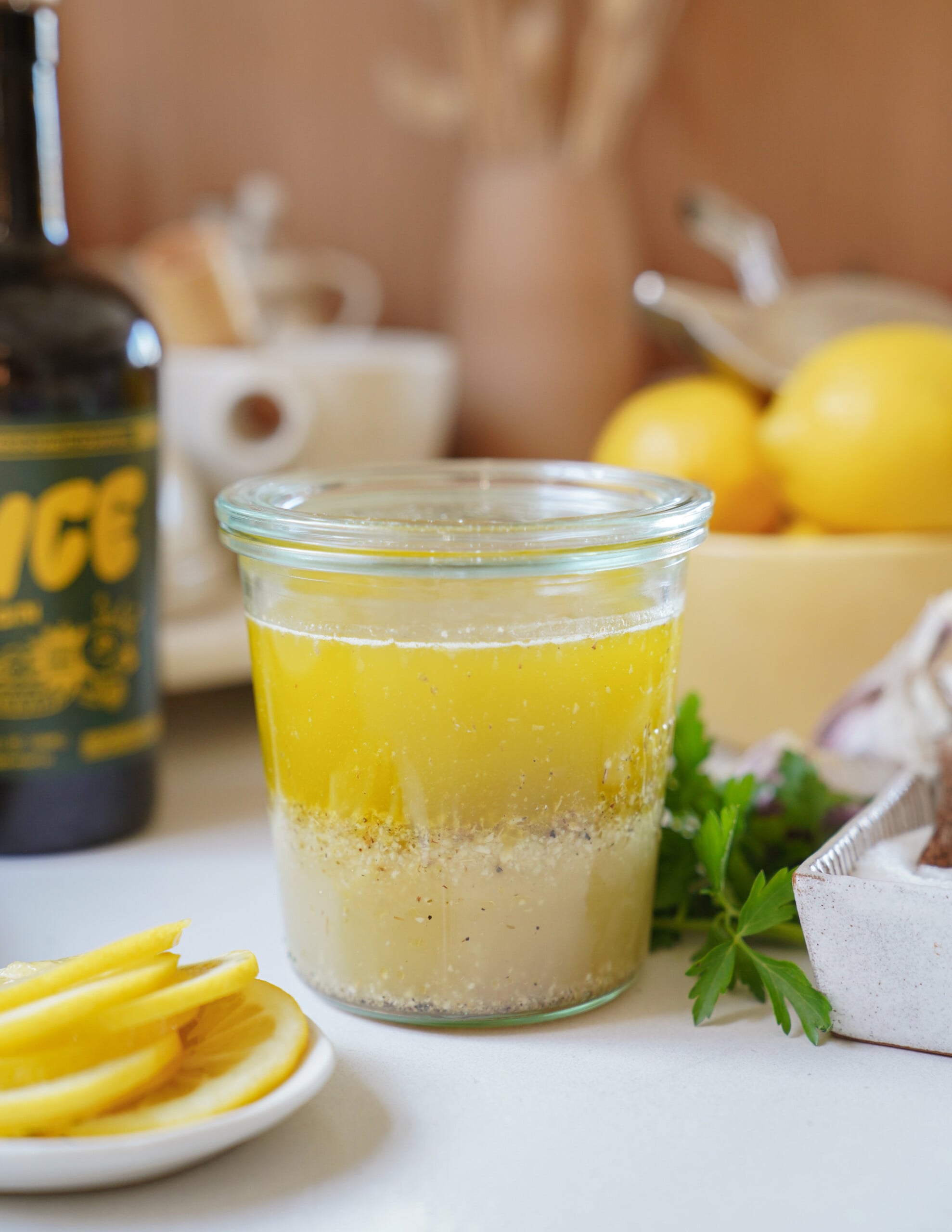
2. Lemons (Lemoni)
If olive oil is the heart of Greek cooking, lemons are the soul.
I grew up watching my mama squeeze lemons over almost everything before serving it. Fish, chicken, greens, potatoes—nothing felt finished without a final squeeze.
In Greece, lemons aren’t an occasional ingredient. In the Mediterranean pantry staples, they’re as essential as salt.
One of the first flavor combinations I learned to love was ladolemono: a simple emulsion of olive oil and lemon juice that somehow tastes like so much more than a few simple ingredients.
To this day, it’s still one of my favorite things to make.
We spoon it over grilled fish, drizzle it onto roasted vegetables, toss it with greens, and use it as a marinade. If you’ve made many of my recipes, you’ve probably noticed I find every excuse possible to work ladolemono into them.
Then there’s avgolemono, perhaps the ultimate expression of the Greek obsession with lemon. Watching eggs and lemon transform into something silky and comforting felt almost magical when I was a kid.
There’s science behind it, too. Acid brightens rich dishes and balances fat beautifully. It’s one reason lemon works so perfectly alongside olive oil-heavy meals.
If you want to try some of my favourites, check out my avgolemono soup, Greek lemon potatoes, or the ladolemono-inspired dressing in this steak salad.
Shopping tip: Buy more lemons than you think you’ll need. Trust me.
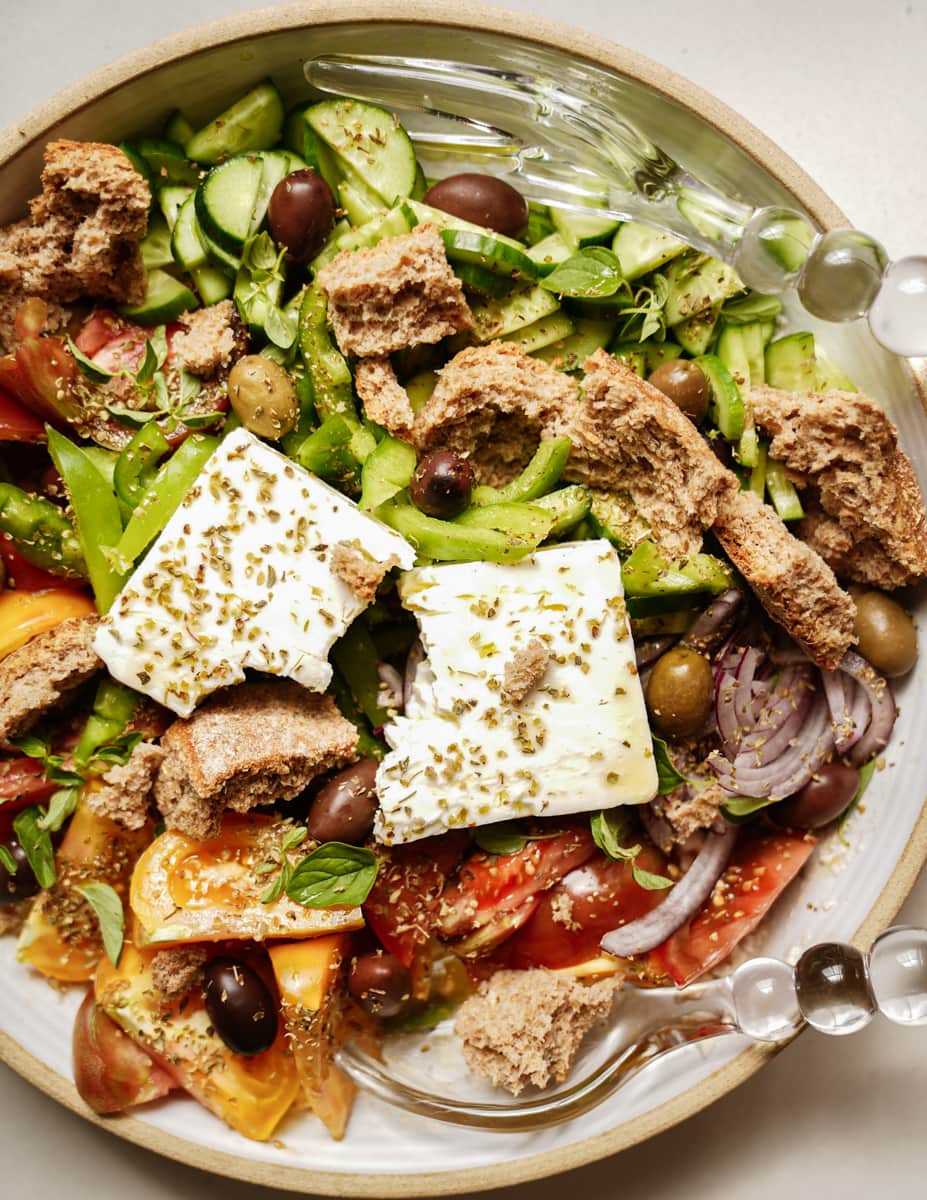
3. Feta
One thing people are always surprised to learn is that feta wasn’t a garnish in my house.
It was the meal.
Or at least part of every meal.
Breakfast? Feta.
Lunch? Feta.
Dinner? Definitely feta.
There was always a block sitting in brine, ready to be sliced and brought to the table. Not crumbled. Not pre-packaged. Not sprinkled over something as an afterthought.
Served as a thick slab with a drizzle of olive oil and a pinch of oregano, feta could easily steal the spotlight from everything else on the table.
Real Greek feta is protected by PDO status, which means it must be produced in Greece using sheep’s milk or a blend of sheep’s and goat’s milk. The texture is creamier, the flavor is tangier, and the overall experience is completely different from many of the cow’s milk versions commonly sold elsewhere.
My family would never have considered those substitutes.
If you’re as obsessed with feta as I am, you’ll love these collections of feta recipes and whipped feta recipes. I also use it in dishes like bouyiourdi and traditional Greek salad.
Shopping tip: Look for Greek PDO feta packed in brine. If it’s sold pre-crumbled, keep searching.
4. Greek Oregano (Rigani)
The smell of rigani instantly transports me back to my yia-yia’s kitchen.
Not the oregano sitting in most North American spice racks.
Greek oregano.
Wild, floral, earthy, and unmistakable.
I can still remember watching my grandmother crumble dried oregano between her palms before sprinkling it over vegetables, grilled meats, or salads. That simple motion is connected to some of my strongest food memories.
Bundles of dried rigani often arrived as gifts from relatives visiting from Greece. Sometimes they came wrapped in newspaper, still attached to their stems, smelling so damn good!
There’s a reason oregano plays such a central role in Greek cooking. In fact, its name comes from the Greek words meaning “joy of the mountain.”
And it truly is.
From grilled souvlaki to roasted vegetables, rigani is distinctly Greek and a Mediterranean pantry staple.
You’ll find it throughout recipes like my chicken souvlaki, Greek chicken marinade, and Greek lamb chops.
Shopping tip: Buy whole dried Greek oregano on stems whenever possible. Crumbling it yourself makes a huge difference.
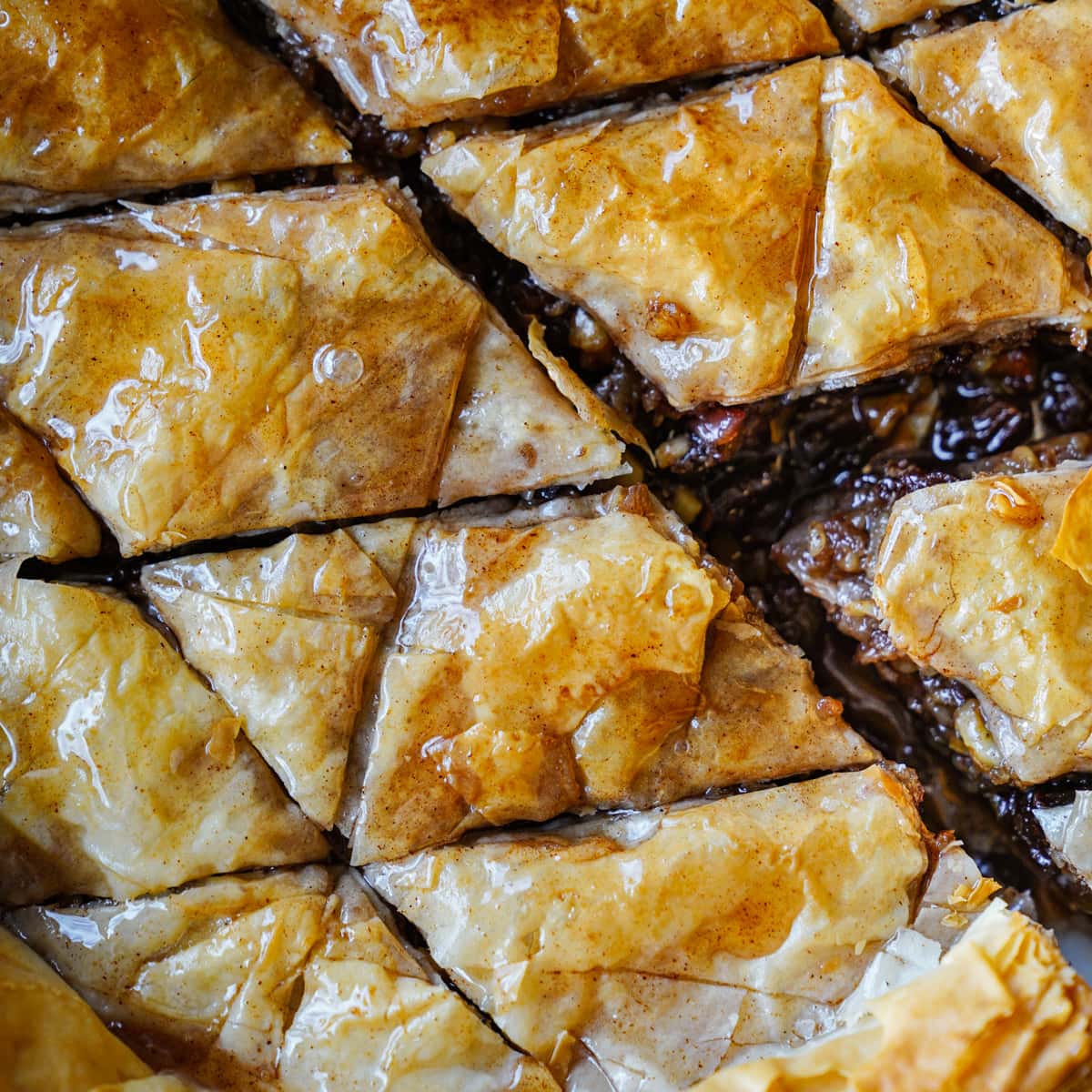
5. Phyllo Dough (Fyllo)
In Greek, phyllo means “leaf.”
And when you see those impossibly thin sheets stacked together, the name makes perfect sense.
Growing up, phyllo was everywhere.
I remember watching my mama carefully keep a damp towel over the stack while brushing each sheet with olive oil. It was patient work, but there was always something special waiting at the end.
Spanakopita.
Tiropita.
Galaktoboureko.
Baklava.
Every region of Greece seems to have its own beloved pie tradition, and phyllo is the common thread connecting them all.
It’s one of the most versatile ingredients in Greek cooking because it moves effortlessly between sweet and savory.
Making homemade phyllo is an art form passed down through generations, but store-bought phyllo is equally common in Greek households. Most families use both.
If you’re looking for inspiration, browse these phyllo dough recipes or some of my favourite Greek desserts.
Shopping tip: Keep a package of frozen phyllo in your freezer. Thaw it overnight in the fridge and never rush the process in the microwave.
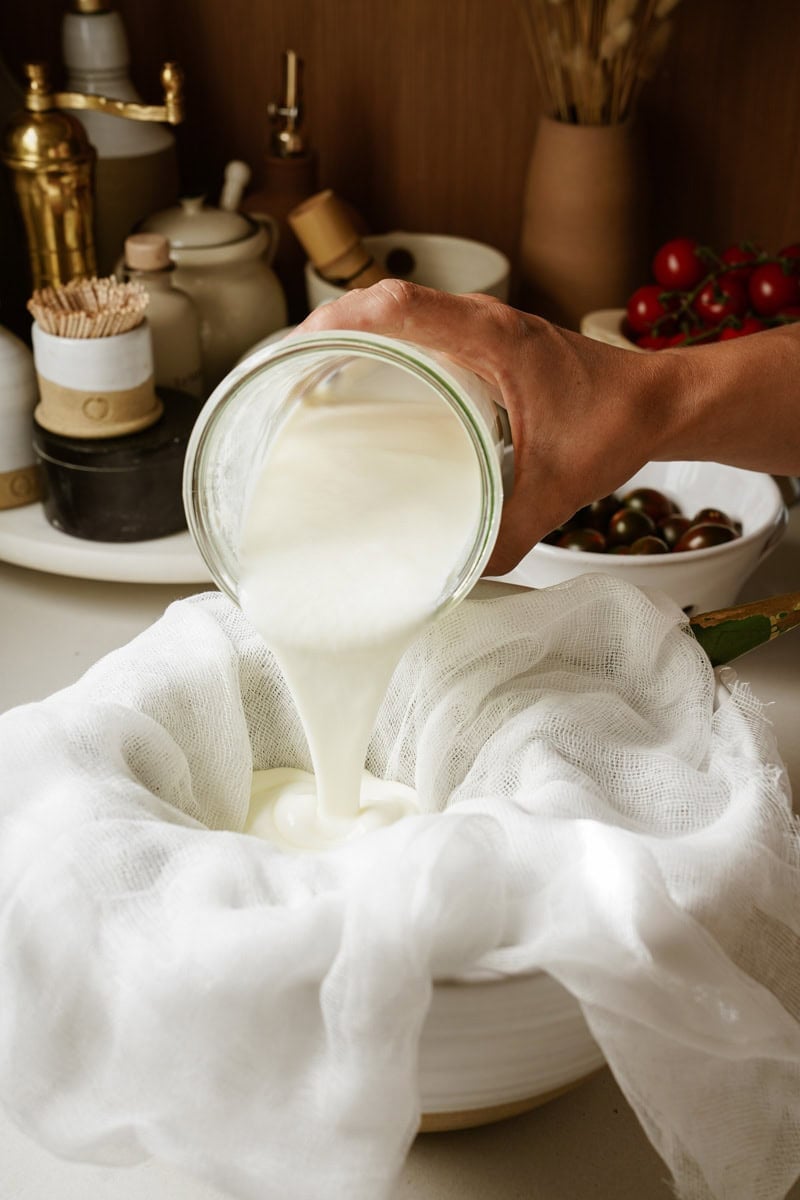
6. Greek Yogurt (Yiaourti)
Long before Greek yogurt became a grocery store trend, it was already a staple in Greek kitchens.
The yogurt I grew up eating wasn’t marketed as a high-protein snack.
It was simply yogurt.
Thick.
Tangy.
Creamy.
And always full-fat.
There was almost always a container in our fridge. We’d eat it for breakfast, enjoy it as a snack, spoon it beside savory dishes, or transform it into tzatziki.
Some of my favourite childhood snacks were the simplest ones, like a bowl of yogurt topped with honey and walnuts.
In Greece, strained yogurt has been part of everyday life for generations. It wasn’t invented for wellness culture. It existed because it tasted incredible.
Today, I still use it constantly in recipes, from dips to marinades.
Try it in these Greek yogurt recipes, my classic tzatziki, or as part of a traditional Greek breakfast.
Shopping tip: Choose plain, full-fat, strained yogurt. The shorter the ingredient list, the better.
7. Pine Honey (Meli)
Of all the ingredients on this list of Greek food staples, Greek pine honey may be the most underrated.
And it might also be my favorite.
When I was a kid, one of the simplest treats imaginable felt like pure luxury: a bowl of thick Greek yogurt drizzled with honey.
That’s it.
No recipe.
No special occasion.
Just a perfect combination.
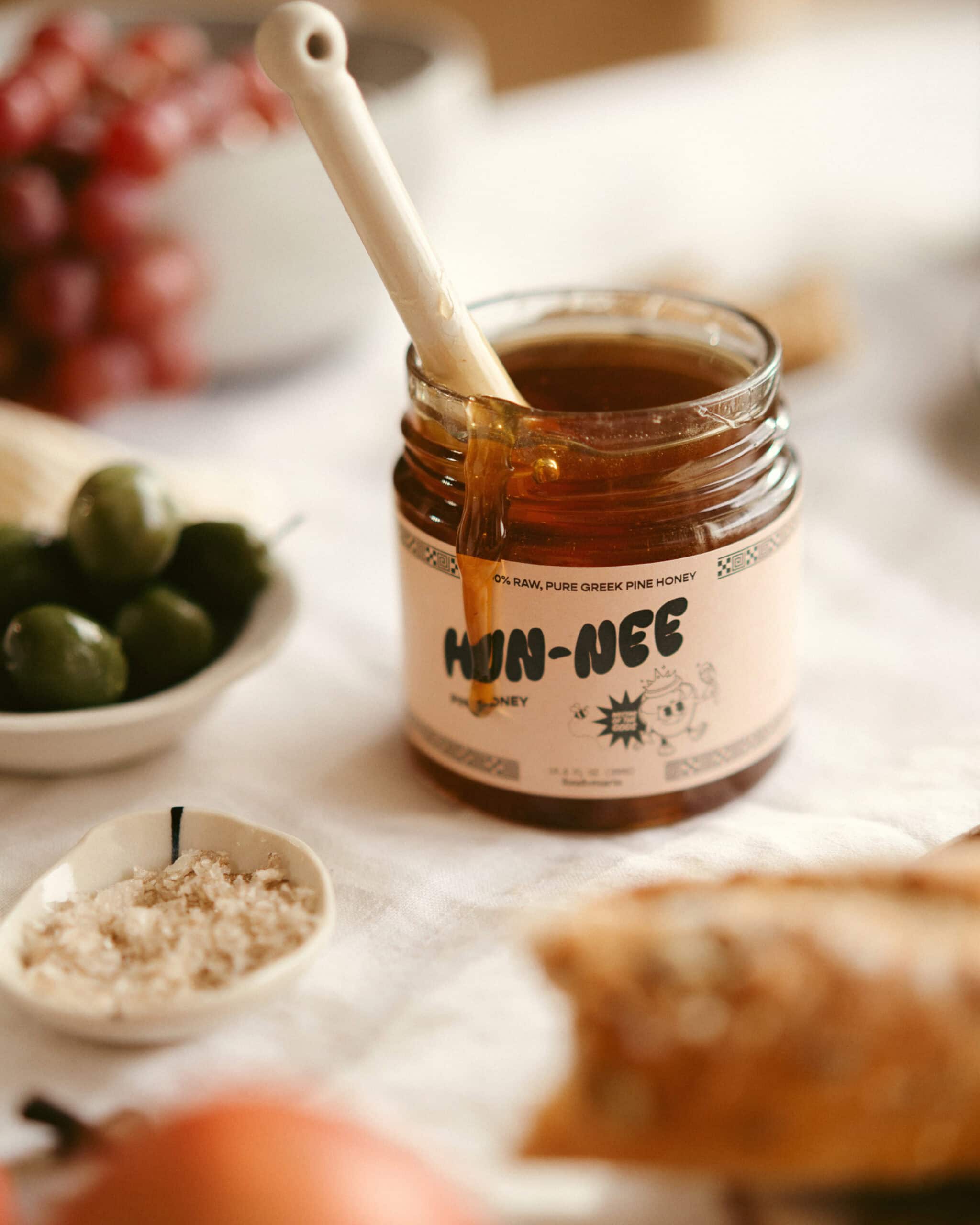
Greek pine honey is unlike most floral honeys. It’s darker, richer, and more complex, with notes of toffee, dried figs, and forest earth. Much of it comes from islands like Thasos, where beekeepers continue centuries-old traditions of moving hives through ancient pine forests.
Honey plays an important role in Greek hospitality and culture. Offering honey to guests is a gesture that’s deeply rooted in Greek history.
And while many people think of honey only as a dessert ingredient, the Greeks use it everywhere. We drizzle it over feta, whisk it into dressings, add it to savory glazes, and stir it into yogurt.
It’s one of those ingredients that quietly elevates everything it touches.
You’ll find it featured in many of my favorite Greek desserts and traditional Greek breakfast ideas.
The pine honey I keep stocked in my own kitchen is HUN-NEE’s raw Greek pine honey from Thasos. It’s the closest thing I’ve found to the flavours I grew up with.
Shopping tip: Look for raw Greek pine honey whenever possible and store it at room temperature. Honey never belongs in the fridge.
The Shopping List That Writes Itself
Looking back, what strikes me most about these seven Mediterranean pantry staples is how ordinary they were.
None of them felt exotic.
None of them felt special.
They were simply there, day after day, meal after meal, quietly shaping how my family cooked and gathered around the table.
That’s the real beauty of Greek food.
It’s not built on rare ingredients or complicated techniques. It’s built on a handful of exceptional staples used consistently, generously, and with confidence.
If you stock your kitchen with olive oil, lemons, feta, rigani, phyllo, yogurt, and honey, you’re already halfway to creating some of the flavors I grew up with.
And if you’d like even more inspiration, recipes, and grocery-list ideas, explore my guide to traditional Greek food and join my newsletter, where I share weekly meal ideas straight from my kitchen to yours.
Because sometimes the best shopping list isn’t really a shopping list at all.
It’s a family story.
2 people are discussing this recipe. Join in
It was truly wonderful to hear about the region’s culinary culture. roblox clicker scratch
thank you for sharing your recipes and heritage with this Scandinavian girl….